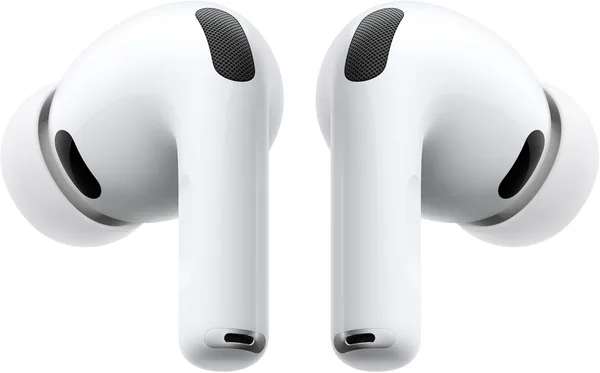
Apple AirPods Pro 3 review: are they worth buying in 2026?
The AirPods Pro 3 aren't a revolution — they're Apple finally polishing what it already knew how to do. Noise cancellation is genuinely, noticeably better than the last generation, Live Translation is a neat trick that's on track to become a habit rather than a gimmick, and the fit is more forgiving. Buy them if you're locked into the Apple ecosystem and you're paying for comfort, not hunting for the cheapest thing that "just plays audio."
Picture a packed morning commute — the train's rattling, someone next to you is watching reels at full volume with no headphones (yes, that happens), and all you want is to finish a podcast episode without losing your mind. That's the moment that actually decides whether Apple's newest earbuds are worth the money, or just another seasonal refresh for people who were buying them anyway.
I'll admit I'm generally skeptical of "third generations" of anything. Usually it's cosmetics — a slightly newer chip, slightly louder marketing. With the AirPods Pro 3, that's not quite true — and not quite false either.
What you actually notice in real life, not in the keynote
Active noise cancellation is the first thing you feel the moment you put these in on a crowded train or at a food court. The previous AirPods Pro were fine at killing steady-state noise — engines, fans, air conditioning. But voices and sharp sounds still leaked through. Here the difference is real: the baseline hum drops further, and crucially, it does that without the odd "ear pressure" feeling you get from cheaper ANC earbuds off a marketplace bargain bin. If you've ever worn something budget with ANC, you know that sensation — like someone stuffed your ears with cotton instead of actually removing the noise. This is different.
The second thing — and I suspect it's the real reason half the people buying this model are buying it — is Live Translation. On paper it sounds like science fiction: you talk in your language, the other person hears it in theirs, almost in real time. In practice, it works, but with caveats. There's a lag, and you notice it in live conversation — a second, maybe a second and a half, which is fine for casual chat but throws off the rhythm of a fast back-and-forth. It shines in a "one person talks, the other listens" format, not in a haggling match at a street market. For travel, for video calls with colleagues abroad, it's a genuinely useful tool, not a feature that exists just to make a checklist.
The heart-rate sensor is its own story. Yes, it's there, and no, it's not a replacement for a proper fitness tracker like a Garmin or even an Apple Watch. But as a bonus during a run, when the earbuds are already in and the watch got left at home, the numbers are perfectly readable. Don't buy these for that alone.
Fit is subjective, and I'll be upfront: my ears aren't exactly "standard," and the first-generation AirPods Pro used to fall out on runs, regularly. The third generation has slightly reshaped tips that sit more securely — though a perfect fit for every ear shape doesn't exist in nature, and never will.
What it's actually up against
The real competition here isn't another Apple model — it's the Samsung Galaxy Buds3 Pro and the Sony WF-1000XM5. Sony still wins on raw sound quality — a more "audiophile" tuning, deeper bass, wider soundstage. But if you're on an iPhone, the ecosystem convenience outweighs the sonic nuances for most people: instant pairing, spatial audio synced with video, volume control without opening an app. Samsung is the logical pick if you're on a Galaxy phone — same story, mirrored.
Compared to the AirPods Pro 2, the upgrade is noticeable but not urgent. If your current "Pros" are in good shape and you have no complaints, you can wait. But if you're still on the first generation, or coming from wired earbuds from your college days, the difference will feel like night and day.
Who should buy these, and who shouldn't
Buy them if: you're in the Apple ecosystem, you travel or talk to people in other languages often, and noise cancellation is a necessity for you rather than a nice-to-have — think open-plan offices, subways, flights. Landed prices vary a lot by country once shipping, forwarding, and import duty are factored in — check the full breakdown for your country on dede.sh before deciding on a budget, because this isn't an impulse buy at this price point.
Skip them if: you're on Android — half the standout features, like a smooth Live Translation experience and spatial audio with video, simply won't unlock. Also skip them if your top priority is clean sound for reasonable money: look at the competitors instead, or go wired altogether, where every dollar goes into the drivers instead of the ecosystem.
The biggest trade-off is battery life with both ANC and Live Translation running at once — it drains noticeably faster than the marketing numbers suggest. If you're planning to wear these all day with active translation on, bring the case. It's not there for decoration.
FAQ
If your current pair works fine and isn't falling apart, no — this isn't the kind of upgrade that justifies replacing a perfectly good pair. The difference is real but not critical for everyday use.
It works, but with a second-to-second-and-a-half lag, so it's best suited to a "take turns talking" format rather than a fast back-and-forth. Useful for travel and working with people abroad, less so for a heated haggling session.
Sony leads on pure sound quality. But if you're on an iPhone, the convenience of the Apple ecosystem matters more to most people than fine differences in bass response — instant pairing and easy controls outweigh the audiophile edge.
They technically work over any Bluetooth connection, but half the appeal — Live Translation, spatial audio with video, seamless integration — only unlocks inside the Apple ecosystem. Android users are better off looking at Samsung or Sony instead.