Apple AirTag review: worth buying if you're always losing things
An AirTag is a small white disc you stick to your keys, drop in your wallet, or toss into a suitcase so you can find it later through the Find My app. It works brilliantly if you have an iPhone and live inside the Apple ecosystem; for Android, it's basically a piece of plastic with a battery in it. It's priced around $29, which isn't cheap for a single tracker, but it does buy you back a few nerve cells.
Ever stood in the middle of your apartment mentally replaying your entire day, trying to remember where you left your keys? That's exactly the moment AirTag was built for. Not some cinematic spy scenario — just the mundane "I genuinely cannot remember where my wallet is."
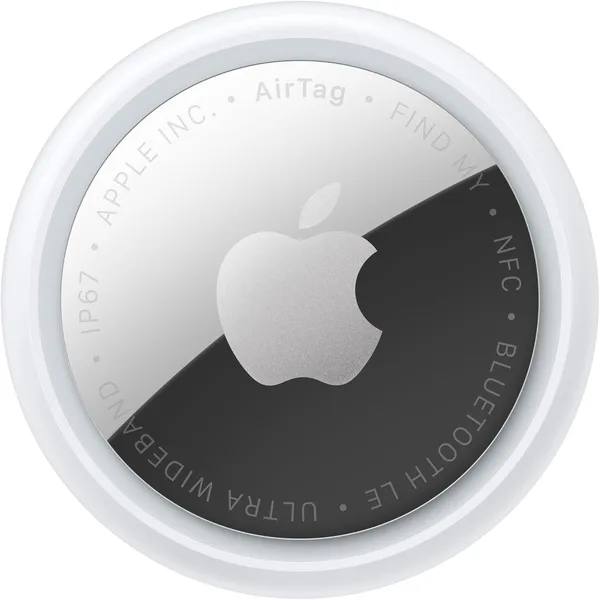
The device itself is a disc slightly bigger than a two-euro coin, white on one side, silver on the other, with an apple logo in the middle. You clip on a keychain loop (sold separately — and that's an extra line item, since a bare AirTag has nothing to attach to your key ring), and now it lives on your keys. Another one goes in a suitcase pocket. A third ends up in the case of headphones you've already left behind in coffee shops twice.
What it's actually like to use
The real magic here isn't the tracker itself — it's the Find My network: millions of strangers' iPhones scattered across the planet that anonymously, without using a byte of their owners' data, ping your lost AirTag and report back where it is. So if you leave your keys in a taxi and the driver drives off with them across town, that driver's phone — without them ever knowing — helps you pin down the location. It sounds a little like magic, and honestly, the first time it worked for me with a suitcase at an airport, I just sat there not quite believing it.
Accuracy is its own conversation, though. From a distance, the map only shows you a rough neighborhood — that's just the GPS of some stranger's phone nearby. But once you're in the same room or car, Precision Finding kicks in (on compatible iPhones with a U1/U2 chip) with an arrow and a distance in meters, and that's where AirTag genuinely pulls ahead of rivals like Tile or Samsung's SmartTag. Tile's network is smaller because it depends on Tile's own user base, which is a fraction of the size of iPhone's install base. Samsung's is the mirror image: excellent if you own a Galaxy, and completely useless if you don't.
And that's exactly where the buying trap lies. If you're on Android — don't. Seriously. Half the functionality just doesn't work; the browser-based tracker for Android users is a crutch that shows you the last known location and nothing more. AirTag is an ecosystem product, not a universal tracker.
The battery is a quiet delight in its own right. A standard CR2032 you swap yourself in ten seconds, good for roughly a year. No cables, no "oh no, I forgot to charge it before the trip." It's a refreshing contrast to the pile of other gadgets in our lives that are constantly begging for power.
The built-in speaker's volume also deserves a mention — not because it's a headline spec, but because it's exactly why a chunk of people buy an AirTag in the first place: when the tracker is close by but you can't see where it's fallen (under the sofa, into a fold of a bag), you just hit "Play Sound" and it beeps loud enough to hear from the next room.
Who it's not for
Parents hoping to track a child's location in real time — forget it. AirTag doesn't broadcast a continuous live position; it updates periodically, and deliberately, for privacy reasons, it warns you if an unknown tracker has been traveling with you for a while (the anti-stalking feature Apple added after the 2022 controversies). That's a fair design choice, but it makes AirTag a poor fit for live-monitoring people or pets — there are dedicated devices with their own GPS module and SIM card for that.
A car isn't the best candidate either: without an active internet connection, AirTag only picks up a signal when someone's iPhone happens to pass by, rather than continuously broadcasting position. For an expensive car, something with its own GPS and cellular connection is the better bet.
The honest verdict
The tracker itself runs around $29 a piece, and if you want to cover keys, a suitcase, a backpack, and a bike, that's already four trackers — add cases and keychain loops and the total adds up fast. On top of the sticker price, factor in shipping and the usual marketplace markups to your country, so think of it as one bundled number rather than counting units — you can see the full landed cost, item plus forwarding plus import duty, on dede.sh before you commit.
But if you're a classic scatterbrain with an iPhone in your pocket, this is one of the rare gadgets that genuinely pays for itself in peace of mind. Not because it saves you every week, but because when it does save you, it saves you big: a suitcase in an unfamiliar airport, keys that rolled under a friend's car seat, a wallet forgotten in a fitting room. Apple AirTag isn't about constant surveillance — it's about that one miserable moment a year when, without it, you'd have lost something for good.
Android users, keep walking — there's nothing here for you.
FAQ
One tracker covers one item, and most people start with their keys since that's the sharpest pain point. If you're also planning to cover a suitcase or backpack, count out trackers per item upfront — multi-packs work out cheaper per unit than buying them one at a time.
Technically yes, there's an app for scanning nearby AirTags you don't own (the anti-stalking feature), but there's no real-time tracking of your own tag. If you're not on an iPhone, AirTag isn't your device — go with a Samsung SmartTag or Tile depending on your phone.
If you have an iPhone, it's AirTag, no contest — the finding network is many times larger and Precision Finding makes accuracy far better. Tile only really makes sense for mixed households with different phone platforms, where cross-platform support matters more than pinpoint accuracy.
Roughly a year of normal use on a single CR2032, and the app warns you well ahead of a low charge. Swapping the battery yourself takes about a minute — no service center required.
![FNTCASE for Galaxy A17-5G Phone Case: for Samsung Galaxy A17 with [Built-in Screen Protector & Kickstand] [Military-Grade Dro](/img/products/fntcase-for-galaxy-a17-5g-phone-case-for-y9hrch/0-600.webp)