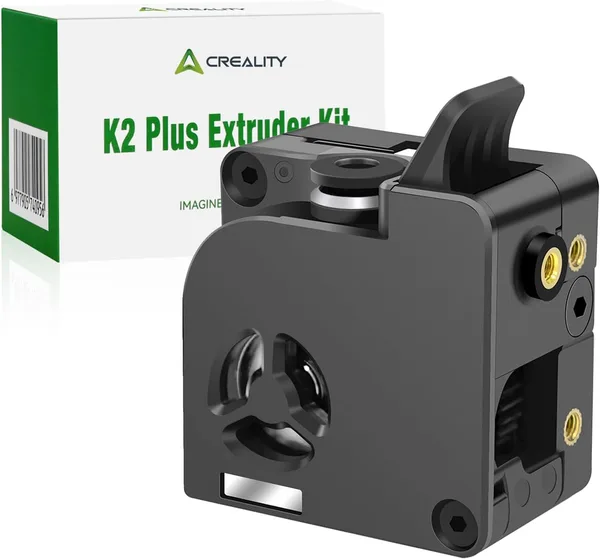
Creality K2 Plus Extruder Kit Review: Better Than Stock?
This isn't an upgrade for the sake of upgrading — it's a repair kit for anyone whose K2 Plus is already clicking its gears at 300mm/s and one of two things, the extruder or the filament sensor, has started acting up. Get it if you print filled plastics (CF/GF) daily and know the extruder is a wear part. Skip it if you own a different printer: this thing physically only fits the K2/K2 Plus.
Ever had this: you walk over in the morning to check on an 11-hour print, and instead of a finished part, you find a wad of plastic wound around the extruder gear and a neatly half-printed drone body sitting on the bed. I have, and that's exactly what got me looking into spare extruders for the K2 Plus instead of just new spools of filament.
The K2 Plus is fast, genuinely fast — 300+mm/s in working modes isn't marketing fluff. But speed has a price: filament feed runs at the edge of its limits, and the stock extruder's dual gears loosen up over time, especially if you're regularly running carbon- or glass-fiber-reinforced plastics — they're basically sandpaper for the feed mechanism. At some point either the teeth on the gears start slipping, or the filament runout sensor, previously a separate module further up the path, starts lying to you and halts the print for no reason in the middle of the night.
That's where the official Creality extruder comes in, with the sensor built right into the feed assembly's housing instead of mounted as a separate board on the frame. The difference isn't cosmetic: a shorter signal path, fewer wires that can chafe against the frame over six months of active printing, and — crucially — the sensor reacts to what's actually happening in the extruder rather than somewhere upstream, where the filament might already be stuck in the Bowden tube without any actual runout.
The gears here are dual, which is basically the standard for any modern direct drive these days, but these are made from hardened steel of increased hardness, and that's the real reason people buy a spare extruder rather than just a new set of gears on its own. The stock K2 Plus gears aren't bad, but they wear noticeably faster on CF nylon or glass-fiber PETG than on plain PLA — that's not a secret and not a reason to panic, just a wear fact you'll need to deal with sooner or later.
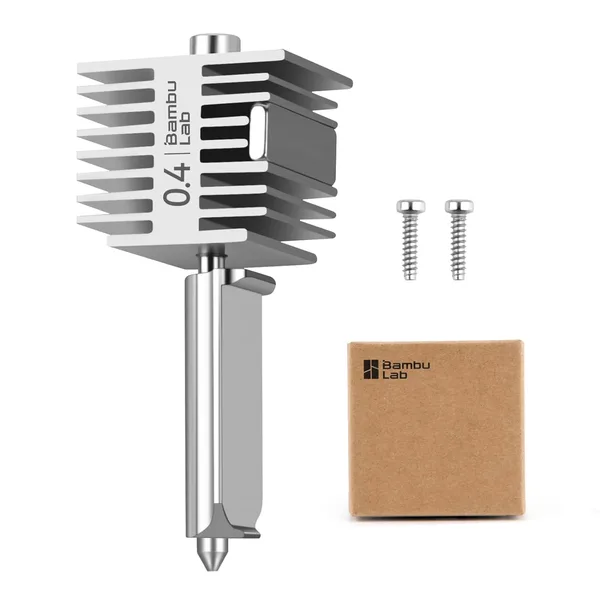
What's the natural comparison point here? The most obvious peer in spirit is the hotend kit for the Bambu Lab A1 mini — the same "official part with a metal hot end and a hardened nozzle" approach, also betting on feed-assembly longevity rather than just print speed. The philosophical difference: on Bambu machines the runout sensor more often lives as a separate module along the filament path or on the AMS unit itself, while here Creality integrated it right into the extruder's body. Personally, I like the second approach better — fewer connections, fewer things that can shake loose from vibration during high-speed printing.
Installation genuinely takes fifteen to twenty minutes if your hands are already used to the K2 Plus and this isn't your first time under the hood. Three connectors, a few screws, calibrating the extrusion steps at the end — a standard procedure straight from the Creality manual, nothing dramatic. But if you've never taken the printer apart before, budget an evening for it, not a quick coffee-break job.
Honestly, the main win here isn't that the extruder became "better" in some abstract sense — it works on practically the same principle as the stock one. The win is that it's an official part that's guaranteed to bolt right into place without wrestling with mounts, which isn't always true of Chinese equivalents from AliExpress at half the price. And the price here, by the way, isn't outrageous — marketplaces sell the kit for roughly $21-25 depending on the seller, which is less than the cost of a single print ruined by expensive filament.
Who definitely should NOT buy this: owners of the Ender 3, any older Creality model, or non-Creality printers in general — the mounts and connectors are built exclusively for the K2/K2 Plus, this isn't a universal part. And second — if your stock extruder is working fine and you mostly print PLA or unfilled PETG, you won't notice this upgrade at all; the money will just go toward a spare part sitting in a drawer. This is a product for people who already know why their extruder wears out, not for people who read the title and think "oh, an improvement, better get it."
The second real trade-off: this is not a "performance upgrade." Printing won't get faster, print quality won't dramatically improve if everything was already working fine for you. This is insurance and a replacement part rolled into one, and you should judge it on those terms.
FAQ
The mounting dimensions are shared across the K2 lineup, but Creality officially positions this kit for the K2 Plus specifically — before buying for a base K2, check the part number against your printer's manual, since revisions differ.
In practice, yes — fewer failure points. A separate sensor on the filament path lives its own life and can get stuck or clogged with dust independently of the extruder, while here everything's in one assembly and there's less to calibrate.
No. Hardened steel proves itself on abrasive materials — carbon, glass fiber, some nylons. On plain PLA or even unfilled PETG the stock service life is already huge, and you won't notice the difference for years.
The most common cause is forgetting to recalibrate the e-steps after replacing the extruder — the feed rate is slightly different from a worn-in original. Run the extrusion calibration from the Creality manual; that usually fixes it.