ELEGOO Mars 5 Ultra 9K Review: Is This Resin Printer Worth It?
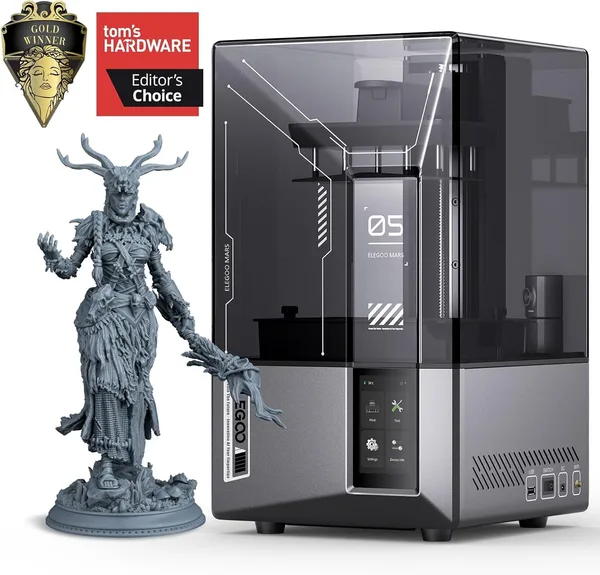
The ELEGOO Mars 5 Ultra isn't a revolution — it's another careful polish of a formula that already worked: a 7-inch 9K screen, a stiffer chassis, and a smart sensor that saves you from the classic "forgot to top up the resin" moment. Check the full landed price — printer plus shipping plus import duty — for your country on dede.sh, but this is shaping up to be one of the smartest entry points into resin printing right now. Just be ready for the smell, the ventilation setup, and the gloves.
There's a moment nobody shows you in the promo videos: you lift the lid on your printer and realize you forgot to top the resin up to the right level — and the print has already been running for half an hour. It's a rite of passage for anyone who has ever printed miniatures or jewelry molds on a resin machine. ELEGOO apparently got the memo, because the headline feature of the Mars 5 Ultra isn't its resolution (impressive as that is) — it's the "smart mechanical sensor" that watches the resin level and warns you before a layer gets ruined.
Let's start with the obvious: this isn't an FDM machine pushing plastic filament through a nozzle. It's MSLA — an LED array shines through a mono-LCD panel, curing liquid photopolymer resin layer by layer. ELEGOO isn't reinventing anything here; it's refining the already well-proven Mars line, which has been practically synonymous with "affordable resin printer" since the original Mars. The 7-inch, 9K screen delivers noticeably crisper detail than the older 6-inch 4K panels — you can see it on fine features like miniature fingers or ring engravings, exactly where the older panels used to leave a faint "stair-step" on curved lines.
What actually changes the day-to-day experience isn't the screen itself — it's how the printer behaves over a long print run. The frame is stiffer, the build plate wobbles less on lift, and that translates directly into fewer failed prints from a part tearing off the plate in the middle of the night. If you've ever stumbled downstairs at 6 a.m. to find your printer dutifully chewing air over an empty vat, you know exactly how much that's worth. The resin-level sensor isn't just for show either — it genuinely flags when it's time to top up, which is a real relief if you print in batches: a party of D&D miniatures, or several jewelry molds in one go.
Now for the less glamorous part, because an honest review has to cover it. Resin printing smells, and no amount of built-in ventilation makes photopolymer pleasant to breathe. Budget for a dedicated corner in the garage or on a balcony, an extractor fan or at least an open window, nitrile gloves, and isopropyl alcohol for washing parts. Compared with popular rivals like the Anycubic Photon Mono or Creality Halot, the Mars 5 Ultra doesn't make this part of the process any easier — it just gives you a better result at the end. Post-processing — washing, drying, curing under sunlight or a UV chamber — is exactly as much of a chore as it's always been.
Second caveat: the build volume here isn't for big objects. This is a printer for miniatures, jewelry molds, small functional parts, and prototypes. Want to print a palm-sized electronics enclosure? Maybe it'll fit, but that's not what this machine is built for. For anything bulky, FDM is usually the better tool for the job anyway.
Who this printer is genuinely good for: tabletop miniature painters (D&D, Warhammer), people making jewelry molds or dental models, and anyone who's already done resin printing and wants an upgrade without paying flagship prices for brands like the Elegoo Saturn or Phrozen Sonic. Who should skip it entirely: beginners who think resin is "just FDM but nicer" (it isn't — it's a whole different level of chemical handling and safety hassle), and anyone without a properly ventilated space to work with liquid resin.
Honestly, this isn't a product that's going to change your life. It's a product that makes the routine a little less annoying for people who already print resin every week. And that's exactly why it's worth a look — not because of hype, but because of a pile of small improvements that add up to saved evenings.
FAQ
FAQ
If you print miniatures with fine detail, yes — the difference is visible to the naked eye, especially on faces and textures. If you're printing simple shapes or large flat parts, the premium won't pay off; get something cheaper with a 4K panel instead.
Print quality is nearly identical — both brands have been trading blows for years. It really comes down to ecosystem: if you already have ELEGOO resins or slicer profiles, stick with the family. Switching over for marginal differences isn't worth the hassle.
The sensor warns you when the level is low, but it doesn't top up the resin for you — it's a smart alarm, not an automated refill system. You'll still need to open the lid and pour resin in yourself; you'll just find out in time instead of after the print has already failed.
Technically yes, as long as the part fits the build volume, but that's not really what this printer is for. For functional enclosures and larger parts, an FDM printer will be both cheaper and more practical — resin earns its keep on fine detail and precision, not on volume.
Similar picks worth checking out before you buy: