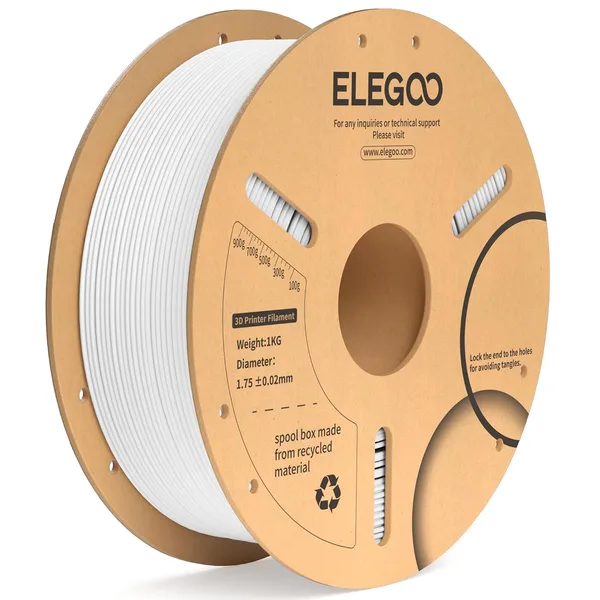
ELEGOO PLA+ White 1.75mm 1kg Review: Worth It Over Regular PLA?
ELEGOO PLA+ White isn't a revolution — it's a quiet upgrade. Same easy printing as regular PLA, but parts survive a drop off the table instead of shattering into confetti. Worth buying if you print things meant to actually function — brackets, mounts, enclosures. For pure shelf decoration, the extra cost buys you nothing.
There was a stretch when I was tossing roughly one in three printed parts — not because the model was bad or the settings were off, but because the thing snapped the moment I pried it off the bed, or cracked against the edge of the workbench. Regular PLA is basically glass. Pretty, easy to print, but glass. That's where PLA+ comes in.
The formula isn't some closely guarded secret: same milk-acid base, just with additives that make the plastic less brittle. ELEGOO didn't reinvent anything here — they took a proven idea (eSUN was really the first big player with their original PLA+) and shipped their own version, cheaper and without the spool-quality drama you sometimes get from smaller niche brands.
How it behaves on the bed
Printed it on a stock Bambu-style profile, no fuss: 200-210°C nozzle, 55-60°C bed, retraction settings same as standard PLA. Zero surprises. That's actually the main reason I recommend PLA+ to beginners over "advanced" materials like PETG or ABS — no enclosed-chamber headaches, no moisture paranoia, and you get noticeably better toughness for free.
The white is nicely neutral — not chalky, not tinted blue like the cheap no-name spools sometimes are. Lays down clean, no visible banding even at 60mm/s. The winding on the spool was tidy too — never once tangled or snagged mid-print, which honestly matters more than people think. I've had spools from other brands where you spend half the print watching to make sure the filament hasn't looped around itself somewhere inside.
The real difference from plain PLA doesn't show up during the print — it shows up after, when you've got the finished part in your hand. I printed a cable bracket, dropped it on tile by accident, and it survived. The same bracket from an old roll of cheap PLA would've split in half — tested that the hard way more than once.
How it stacks up against the obvious competitors
Compared to eSUN PLA+ — the difference is minimal, both are solid choices and I wouldn't argue hard for either one. Against Bambu Lab PLA Basic (the plain version, not their PLA+) — ELEGOO PLA+ is clearly tougher against breaking, though Bambu edges it out on dimensional consistency if you're running an AMS and need color to match perfectly batch to batch.
Compared to generic "budget" PLA off the open market or unbranded stuff from AliExpress — it's a different league entirely. That cheap filament often drifts on diameter (±0.05-0.08mm instead of ELEGOO's claimed ±0.02mm), and you feel it in extrusion — under-extrusion in one spot, blobbing at the seam in another.
Who should buy it, and who shouldn't bother
Buy it if you print functional things: mounts, electronics enclosures, bike or car parts, toys that kids will actually throw around and chew on. The premium for "plus" pays for itself the first time a part survives a fall off the table.
Skip it if your printer's whole job is miniatures, statuettes, or shelf decor — brittleness just doesn't matter there, and your money's better spent on a color or specialty filament with some visual flair (silk, metallic). Also skip it if you're running an old budget printer without decent part cooling — PLA+ is a bit fussier about cooling on overhangs and bridges than classic PLA.
The real trade-off isn't price (it's nearly identical to regular PLA) — it's that PLA+ behaves slightly worse on very thin walls and sharp bridges. Sometimes you need to drop speed by 5-10% to avoid sagging. Minor, but worth knowing upfront instead of finding out the hard way.
What it actually costs, and whether ordering internationally is worth the hassle
A spool runs around $12 on the US marketplace — the kind of money that gets you unbranded no-name filament in a lot of local stores. Once you add forwarding and import duty for your country, the full landed price comes out quite a bit higher than the sticker — check the product page to compare shipping routes and find the cheapest option for where you live.
Honestly, for a single spool, dealing with an international order only really pays off if you buy several rolls at once or bundle it with other purchases in the same package — that's when the fixed shipping cost gets spread thin enough for the savings to actually show up.
FAQ
If you're printing anything that needs to survive drops or mechanical stress — yes, and the premium is usually minimal or nonexistent. For purely decorative models, the difference doesn't really matter.
Nearly identical on paper. eSUN's been around longer and has the reputation as the benchmark, but ELEGOO holds its own in practice and often comes out cheaper when ordering internationally.
No, it prints on a standard PLA profile — 200-210°C, 55-60°C bed. The only tweak is slowing down slightly on thin bridges and making sure part cooling is working properly.
For occasional printing of functional small parts — brackets, holders, mounts — a kilogram lasts several months. If you're printing daily or doing large models, it's worth looking at ordering multiple spools upfront.