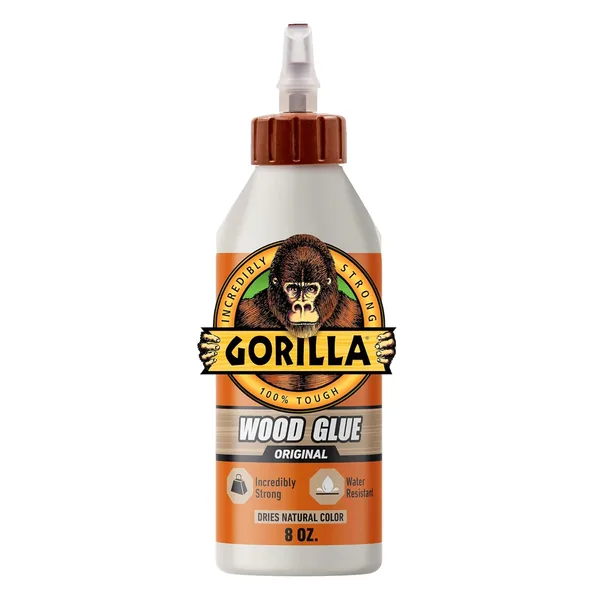
Gorilla Wood Glue 8 oz Review: Is It Worth Switching From Titebond?
Gorilla Wood Glue is a fast-setting, water-resistant PVA that bonds wood stronger than the wood itself, if you get the technique right. For furniture, shelving, and outdoor repairs, it's a solid pick. For boatbuilding or projects that need a long open time, stick with Titebond III.
Glue two boards, clamp them, and twenty minutes later you're rubbing the seam with your thumb — and it won't budge. That's roughly how most people meet Gorilla Wood Glue for the first time, especially if they've only ever used the standard hardware-store PVA that needs an hour or two under clamps before you dare touch it. The difference is obvious immediately, which is exactly why this glue built a cult following among hobbyist woodworkers — and why it's now showing up on more workbenches outside the US too.
What this glue actually is
Gorilla Wood Glue is a next-generation PVA: yellowish, thick, without the sharp smell you get from epoxy, and it dries to a natural beige that all but disappears under stain. The maker claims a clamp time of roughly 20-30 minutes and a full cure in 24 hours — and that's not marketing fluff, it holds up in practice. I used it to glue pine slats for a shelf: clamps came off after half an hour and the joint had already stopped moving, though I didn't put it under real load until the next day.
The headline feature is water resistance — not to be confused with waterproofing. The glue passes the ANSI/HPVA Type II test, meaning it shrugs off humidity, rain, and condensation in a garage or on a porch. But for pieces that sit in constant contact with water — cutting boards, garden furniture left outside year-round — that's not enough protection. You'd want epoxy or a Type I-rated glue like the ones used in marine builds.
Against a classic white PVA (Titebond Original or generic "wood glue" from the hardware store), Gorilla wins on speed and bond strength. There's a catch, though: it works a bit "twitchy." Your open assembly time is shorter than with the competition. If you're putting together a multi-piece build and like to take your time nudging everything into perfect alignment, you can easily run out of window before the edges start grabbing.
Where it genuinely earns its keep
Gorilla Wood Glue shines when you need fast turnaround: a shop with few clamps and a lot of parts to glue. Bond a joint, pull the clamp after 20 minutes, load the next pair — rinse and repeat. For weekend woodworking at home, where you typically own two or three clamps total, that saves an entire evening.
The second scenario where it pays off is repairing outdoor furniture and structures that get rained on occasionally but don't sit in standing water — a fence, a swing set, a gazebo tabletop. That's exactly where Type II water resistance belongs, without paying a premium for marine-grade glue you don't actually need on dry land.
Who should skip it: if you're building knockdown, IKEA-style furniture that needs some flex in the joint — wooden toys that will spend years in kids' hands and need to survive bending, for instance — go with something slower-curing and more elastic. And if you're working on a complex multi-part assembly that genuinely needs 10-15 minutes to square everything up, Titebond III's longer open time is the better tool for the job.
Honest verdict
I'd recommend Gorilla Wood Glue to anyone doing simple home woodworking projects: shelves, frames, small furniture repairs, outdoor structures. It's not a glue for a professional shop gluing 50 complex joints a day — those shops mostly still stick with Titebond for its predictability and longer working time.
Two real trade-offs worth knowing upfront. First, the short positioning window: if your build is complicated, stage every part and clamp before you apply glue, because reworking a joint that's already grabbed is a losing battle. Second, this still isn't fully waterproof, and for furniture that lives in constant contact with water, look elsewhere.
Check dede.sh for the full landed price to your country — item cost, forwarding, and import duty rolled into one number — before you decide. It's not the cheapest wood glue on the market, but it's not premium-priced either, given how far one bottle stretches across home projects. For comparison, keep Titebond III in mind — essentially the direct competitor, with a longer open time and a slightly different balance of price and performance.
FAQ
For simple joints where you want to pull the clamps quickly, go with Gorilla. For complex multi-part assemblies that need time to align, pick Titebond III — it has a longer working time and slightly better water resistance.
For occasional rain and moisture, yes, it's water-resistant. But for furniture that stays wet constantly or sits fully exposed outdoors all year with no cover, go with a Type I-rated glue or an epoxy instead.
The manufacturer says 20-30 minutes for positioning, and that checks out in practice. But don't put the joint under full load until a full day has passed — before that, the bond hasn't fully cured.
Yes, with room to spare. A 236 ml bottle covers several small projects — shelves, frames, minor furniture repairs — as long as you're not slathering on glue "just in case" in thick layers.
Similar products, if you're looking for an alternative or a second adhesive for the shop: