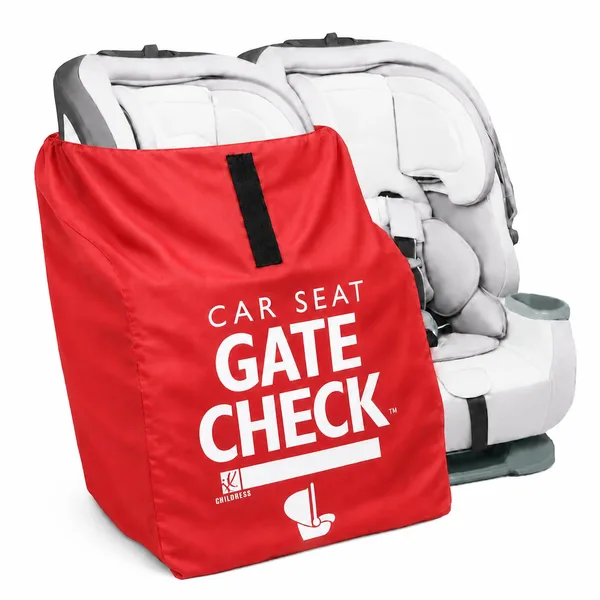
J.L. Childress Gate Check Travel Bag Review: Worth It for Flying With a Car Seat?
A simple but well-thought-out nylon bag that saves your car seat from scratches, grime, and snapped buckles when you hand it over at the gate. It's not armor and it won't stop a careless baggage handler, but it folds down into a little pouch and costs pocket change next to a replacement seat. Worth buying if you fly often or your seat is pricey — for a single trip, plastic wrap will do.
Picture this: you've just buckled your kid in on the plane, breathed a sigh of relief — and then remembered that the $200 car seat you gate-checked is now riding the conveyor belt straight across the tarmac, no protection at all, wedged between suitcases, skis, and someone's orange umbrella. That's exactly the moment a gate check bag earns its keep — and exactly why this product category exists in the first place, rather than being just "another accessory."
What it actually is, and why it exists
J.L. Childress is a US brand that makes almost nothing but travel gear for parents: stroller bags, organizers, and — the subject here — car seat covers. The Gate Check Travel Bag is a big nylon sack with a drawstring closure and a shoulder strap, roomy enough to swallow pretty much any car seat — from a compact infant carrier to a bulky convertible seat for a toddler. The manufacturer lists a capacity of 172 liters, and that's not marketing fluff: nearly everything sold in a baby store actually fits.
The bag itself weighs just 204 grams and folds down into a small pouch you can stash in a diaper bag or a backpack pocket right up until the gate agent takes the seat from you. That's its main edge over the alternatives: the stretch wrap some airports offer for a few bucks, or a bulky zippered cover you're stuck lugging around empty for the entire flight.
How it holds up in real travel chaos
The whole point of gate-checking is to hand over bulky kid gear — a stroller, a car seat — right at the boarding door instead of at check-in, then get it back on the jet bridge or right after deplaning. That's convenient: your child stays in the seat or stroller until the very last minute. But between "handed over" and "picked up," the seat rides in the cargo hold with everything else, and that's where it usually picks up scratches, cracked harness buckles, or a snapped-off cup holder.
The bag won't make your car seat indestructible. Let's be honest: if a handler drops it from height or wedges a heavy suitcase on top, fabric isn't saving the plastic shell. But against the everyday stuff — grime, conveyor belt grease, minor scuffs on the plastic, straps snagging on other people's luggage — it does its job well. And importantly, it tucks all the straps and buckles out of sight, so they can't catch on anything and get torn off during handling.
Compared to a Cosco Scenera cover or the generic no-name bags out there, the J.L. Childress has noticeably sturdier stitching, and the drawstring doesn't start fraying after the third flight — something that becomes obvious fast if you fly with a car seat regularly rather than once a year on vacation. On the flip side, there are pricier options with rigid corner inserts; they're heavier, bulkier, and overkill for most families.
Who actually needs this, and who doesn't
If you fly with your kid once or twice a year, honestly, free airport shrink wrap or an old shoe bag will get you through — the seat will survive. But if you're a frequent flyer, your seat is expensive (modern convertible seats easily run $150-250), or you'd simply rather not watch it disappear down the conveyor belt with your stomach in knots — the bag pays for itself the first time it saves you a buckle replacement or a repair.
There's one real downside: it's just a drawstring sack, no rigid frame, no wheels. You'll be hauling a big, awkward bundle across the entire terminal on your shoulder or in your hands, and that's not always fun, especially with a kid in one arm and a diaper bag on the other shoulder. If you want something with a handle you can roll along the floor, look elsewhere — this isn't that product.
On Amazon US, prices for the base version start at around $13 — this isn't a purchase that requires much deliberation. Once you add shipping and your country's import duty, the total climbs a bit, but it stays firmly in "accessory" territory, not "investment." For the full landed price to your country — item, forwarding, and duty rolled into one number — check the listing on dede.sh.
Bottom line
This isn't a groundbreaking invention — it's a narrow, well-aimed fix for one specific problem, and it solves it. Light, compact, genuinely protects against grime and minor damage, and disappears into your carry-on when not in use. Don't expect bulletproof protection, and be ready to sling a bulky bundle over your shoulder. For families flying with kids more than once a year, it's a sensible, cheap buy.
FAQ
Yes — the listed 172-liter capacity is specifically sized for bulky convertible seats meant for toddlers, not just compact infant carriers. That's the whole reason people go for this universal size instead of a narrower, seat-specific cover.
If your seat is especially expensive, or you're flying budget carriers with ground crews that aren't exactly gentle, maybe. For most families, the plain soft nylon version is plenty, and the extra weight and bulk of the rigid option get old fast.
Plastic wrap protects against grime once, and poorly, but it's free. The bag is reusable, tidier, and does a better job keeping straps and buckles from snagging on things. If you fly more than twice a year, the bag pays for itself quickly.
Less critical, since a seat checked at the counter spends longer unsupervised in the cargo hold. But protection against grime and snagged straps still matters either way — it's just a lower priority than with a gate check.
Similar products worth a look: