Creality PLA Filament 2kg 1.75mm Review: Worth It for an Ender
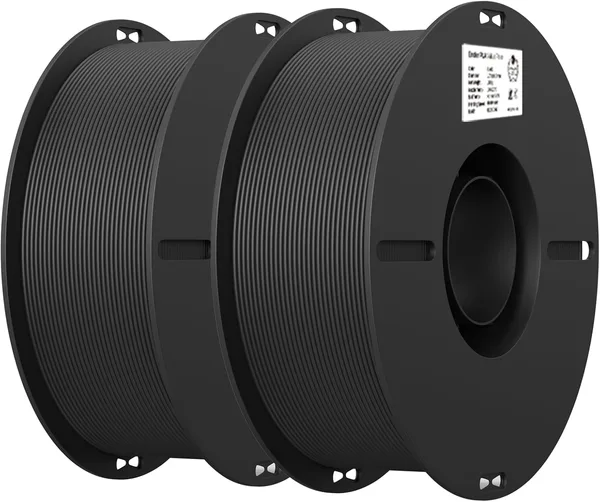
This is two kilograms of standard PLA from Creality, packaged as a 1.75mm bundle — no surprises, no fancy marketing, just plastic that prints consistently on an Ender and similar printers. Not the cheapest or the flashiest option on the market, but it's nearly guaranteed to be free of jams and diameter swings. Buy it for everyday printing; look elsewhere for collectible colors or premium properties.
You buy your first printer, celebrate for a week, and then hit a wall: half the spools people recommend on forums either snap mid-print or leave little "ears" on corners because the diameter drifts by half a tenth of a millimeter. Suddenly you're not thinking about design anymore — you're wondering if this print will survive till morning. That's exactly why the question "which spool should I buy first" matters more than "which printer should I buy."
That's where the Creality PLA 2-kilogram bundle comes in — not because it's some stroke of genius, but because it's that rare case where the printer manufacturer also makes the consumable, and it's simply bad for business if their own spool damages the reputation of their own Ender.
What this plastic actually is
PLA is the simplest 3D printing material, and that's exactly why it's easiest to notice the difference between a good batch and a bad one. Bad is when the strand goes thin, then thick, the nozzle clogs, and the model comes out with telltale bumps on the walls. Good is when you load the spool, forget about it, and only remember it exists when it's time to swap it out.
The 2kg bundle is essentially two 1kg spools, and there's a practical reason for that: if you have an Ender 3 or any budget printer with a small spool holder, one giant 2kg reel might physically not fit or overload the feed mechanism. Two separate spools fit anywhere and don't get in the way when swapping colors mid-project.
This filament prints predictably. I wouldn't call it impressive — it's not the kind of plastic you brag about in a maker chat. But it doesn't let you down where cheap no-name filament does: the 0.4mm nozzle doesn't clog, layers lay flat, supports snap off without drama. For some, that's boring. For anyone who's already burned through three failed attempts at printing a shelf bracket, that's exactly what you need.
Where it genuinely shows its strengths
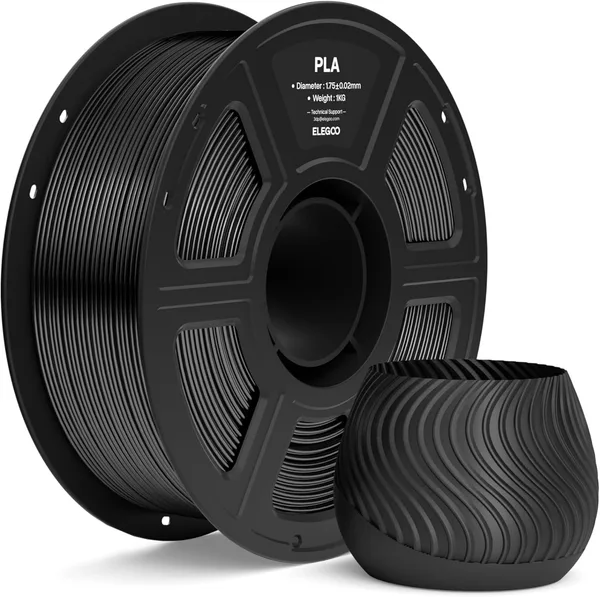
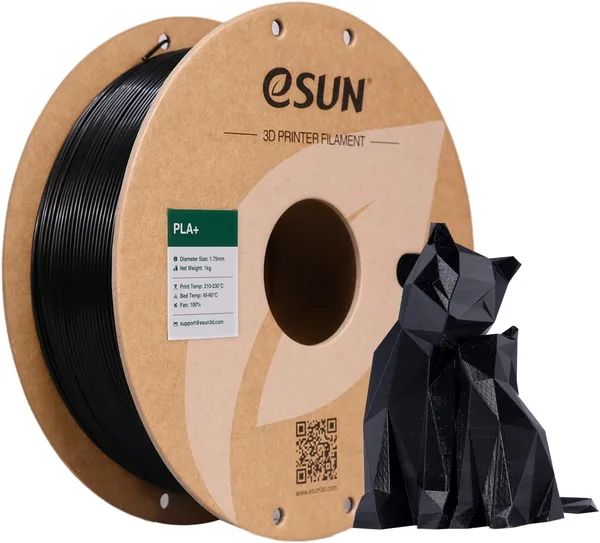
Comparing it to PLA from eSUN or Elegoo — the most obvious competitors in the same price bracket — there's no fundamental difference in base quality. PLA is a fairly standardized material, and top brands cook it from roughly the same pellets. The difference shows up in the details: Creality's winding is a bit more stable, less filament tangling, less chance it "locks up" on itself inside the spool during a long print. A minor thing, until it happens eight hours into printing a large part — then it's not minor anymore, it's a ruined evening.
The downside is that this is strictly "basic" PLA, not PLA+ or any hybrid with enhanced impact resistance. If you need a part that survives a drop or mechanical load — a functional bracket, a gear, a device enclosure — this plastic will be somewhat brittle, as, honestly, most regular PLA is. For figurines, mockups, decor, shape prototypes (not strength) — more than enough.
Price plays a role too: this spool runs around $23-24 for 2kg, a fair middle-of-the-market rate — not the cheapest you can find, but not an overpay for the brand name either. For the full cost with shipping and import duty to your own country, check the landed price on dede.sh — worth knowing upfront rather than being surprised at checkout.
Who should buy it, who shouldn't
Worth buying if you have an Ender or a compatible budget printer and you're tired of the lottery of unknown filament brands. This is exactly the case where predictability matters more than experimentation: you load the spool and go to bed, and in the morning you pick up a finished model, not a pile of spaghetti with a jammed nozzle. It's also a good fit for anyone who prints often and across multiple projects at once — 2kg will last a good while, and you won't need to reorder weekly.
Not worth buying if you need special properties — flexibility, impact resistance, heat resistance beyond standard PLA. And not if your main criterion is a unique color or effect (silk, pearlescent, glow-in-the-dark): this is a basic, mostly solid-color material with no fancy tricks, and paying premium-filament prices for it doesn't make sense.
The trade-off here is honest and simple: you don't get anything special, but you're almost guaranteed not to get a headache either. For a first printer or a daily working cycle, that might be the single most important quality of all.
Honest verdict
This isn't a product worth writing an ode to. But it's exactly the product that does its one job — consistently extruding layer after layer — without making you google "why does my filament keep snapping" at 1am. For a beginner with an Ender, or anyone who wants to settle the "which filament to buy" question once and for all, this is a smart, boringly reliable choice, in the best sense of the word.
FAQ
Yes, this is standard 1.75mm PLA, physically compatible with any printer built for that diameter — Prusa, Anycubic, Bambu Lab, all using the same nozzle sizes. The "for Ender" label is about marketing and proven compatibility, not a technical restriction.
If you're printing decor, figurines, or shape prototypes — no, regular PLA is plenty. The extra cost of PLA+ pays off only for functional parts that face real mechanical stress — brackets, gears, mounts.
The difference isn't in the chemistry of the material, it's in the consistency of winding and filament diameter. No-name filament often suffers from thickness variation and tangling on the spool — either of which means a clogged nozzle or an uneven layer. You're paying a bit more here specifically for predictability, and for a beginner, that's worth it.