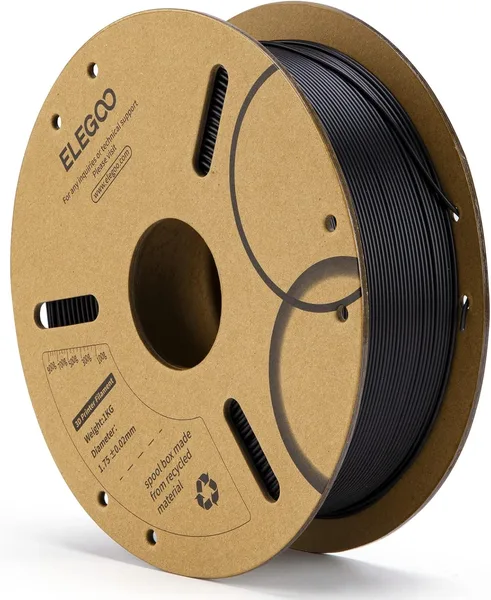
ELEGOO PLA Filament 1.75mm Black 1kg: Is It Worth Buying
ELEGOO PLA 1.75mm black is a consistent, no-surprises filament: diameter accuracy holds up, and it prints reliably on almost any FDM printer. It's not the cheapest option out there, but this is one of those cases where the premium buys you a stress-free print. Get it if you want to stop recalibrating your extruder every time you load a new spool.
You know the drill: you buy a spool "just because it's there," then spend a third of your evening fighting flow settings because the filament is 0.1mm thicker in one spot and thinner in another, and the printer spits out blobs instead of a part. I've been through that maybe fifteen times before I finally stopped chasing brand names and started checking the actual quoted diameter tolerance.
ELEGOO lists ±0.02mm here, and refreshingly, that's not just a number for the spec sheet. I checked it with calipers at several points along the spool, and the variance really is minimal — prints come out without sudden under-extrusion or blobbing. If you remember the bargain-bin spools labeled "no-name 1kg, dirt cheap," where the diameter would wander up to 1.85mm and clog the nozzle, this is simply a different league.
How it behaves in real prints
Black PLA is probably the single most popular color out there — it covers everything from enclosures and brackets to prototypes and the odd gift trinket. ELEGOO doesn't overthink it here: standard print temperature, roughly 190-220°C depending on speed and printer, and the bed can run unheated or at just 50-60°C, with everything sticking fine even without glue or hairspray. There's almost no smell, which genuinely matters if you're printing in a living room rather than a garage.
The surface finish on printed parts comes out matte, a deep black without the grayish tint you sometimes get from cheaper filaments. Fine details — text, thin walls, threads — print cleanly, no stringing between features, as long as your retraction is dialed in reasonably. This isn't a filament that forgives sloppy settings entirely, but it doesn't demand you polish them to perfection either.
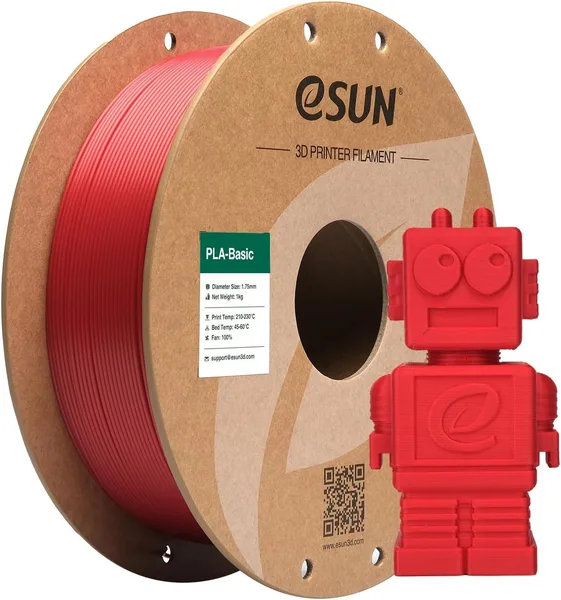
Compared to eSUN PLA Basic, another catalog staple that often gets treated as the budget benchmark, ELEGOO holds diameter consistency slightly better spool to spool — at least based on my own testing and what I've seen in user reports. The difference isn't dramatic, but if your printer has no filament-runout sensor and any jam means a ruined part after two hours of printing, that consistency is worth the money.
The spool itself is a standard size that fits pretty much any holder, and the filament stays dry in its sealed bag with a desiccant pack — which matters for PLA, since it happily soaks up moisture from the air and then crackles and bubbles mid-print.
Who it's for, and who should skip it
If you print occasionally — prototypes, household parts, figurines — this is exactly the kind of filament that won't make you swear at your printer. It's especially good for beginners: forgiving of minor setting mistakes, and it behaves consistently across different machines — Ender 3, Prusa clones, Bambu Lab, anything with a decent hotend.
If you're printing at industrial scale, by the ton, and every cent per kilogram matters, look toward cheaper options and budget for a slightly higher failure rate. Saving money on bulk filament is sometimes the right call even if it means restarting a print once or twice.
One honest trade-off worth mentioning: this isn't the most exciting color choice if you're after effects like silk or shimmering matte — you get a plain, even deep black and nothing fancier. And that, to my mind, is an honest workhorse color, not a premium showcase line.
For the exact landed price to your country — filament, forwarding, and import duty rolled into one number — check the listing on dede.sh.
That same black PLA from ELEGOO is a solid default pick if you'd rather not gamble on whether a spool will let you down.
Bottom line
Get it if you value predictability over shaving off a few cents. Skip it if you print in bulk and are willing to live with the occasional failed print to save on cost — in that case, look toward cheaper rolls and budget for some waste. For a home maker, hobbyist, or small workshop, this is one of those filaments that simply works, and you forget about it fast, because it never gives you a reason to think about it.
FAQ
Not really. PLA in general forgives an unheated bed, and with ELEGOO parts stick even without one — though 50-60°C does improve adhesion on larger flat areas and lowers the odds of corners lifting.
Both are decent budget picks. eSUN is a bit cheaper and also fine for beginners; ELEGOO holds diameter consistency better spool to spool. If your printer has no jam sensor, I'd go with ELEGOO for peace of mind.
Plenty for one medium-sized enclosure or a handful of small parts. For a large functional prototype with high infill, you might come up short — better to check the weight estimate in your slicer beforehand than to run out mid-print.
If you print regularly, absolutely — it has a direct impact on extrusion consistency and how many parts you end up throwing away. If you print one small thing twice a year, you probably won't notice the difference.