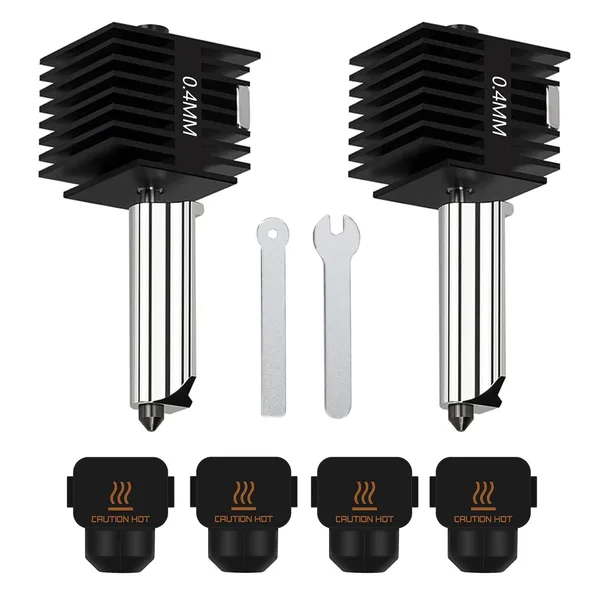
HzdaDeve 0.4mm Hotend for Bambu Lab A1/A1 Mini/A2L: Worth It or Not
This two-pack of hardened-steel 0.4mm hotends for the Bambu Lab A1, A1 Mini and A2L costs less as a pair than a single genuine spare. Hardened steel really does outlast brass on abrasive filaments — carbon fiber, glitter, wood-fill — but for plain PLA/PETG it's overkill. The real risk is fit tolerance: some buyers get a seal that's a touch looser than Bambu's own, so test the first print on something forgiving before you trust it.
You know the moment: the printer nails a flawless first layer, and then on print fifty the nozzle suddenly starts weeping plastic. Anyone printing more than keychains has hit this. On the Bambu Lab A1 and A1 Mini the hotend is a swappable unit, so fixing it isn't a soldering-iron job — it's one screw. The only question is what you swap it for: the eye-wateringly priced genuine part, or a Chinese two-pack like this one.
Why swap the whole hotend and not just the nozzle
On the A1 series, the hotend is a pre-assembled module — nozzle, heater block and thermistor all in one piece that pops out without touching the rest of the hot end. Great for fast servicing, less great for your wallet: Bambu's own replacement costs noticeably more than a plain brass nozzle would on most other printers. That's the gap the HzdaDeve 2-Pack 0.4mm steps into — two hotends built from hardened steel instead of the stock brass.
The steel-versus-brass difference isn't marketing fluff. Brass is soft; it conducts heat beautifully, but any abrasive filament — carbon- or glass-filled PLA, metal-loaded blends, glittery PETG — wears out the nozzle bore within a spool or two. The hole goes oval, seams start drifting, line widths get inconsistent. Hardened steel holds its geometry far longer. The trade-off is slightly worse thermal conductivity, so on paper, with filaments that need to heat up fast, a steel nozzle is a touch slower to reach temperature. In practice, with the A1's stock heatsink, you won't notice.
How it actually behaves on the printer
The feature the manufacturer leads with is "leak-proof" — a tight seal between nozzle and heater block that keeps molten plastic from seeping into the gap. That's the classic failure point for cheap knockoffs: an imperfect fit lets gunk build up, a small ooze appears, and within a few weeks the nozzle starts "crying" during pauses. Most A1 and A1 Mini owners report the fit is snug and trouble-free. But there's a minority report too — some users find the seal a little looser than stock, with faint seepage on the first few prints until it beds in. That's a familiar pattern with no-name hotend makers: batch-to-batch variance is real.
So do this after installing: don't send your first print straight to a finished part. Run a calibration tower or just a plain box. Clean seams and no ooze near the nozzle on the early layers — great, print away and stop worrying. If you do see some — don't panic, one more heat-cool-retighten cycle usually finishes the job; the seal doesn't always settle on the very first heat cycle.
A2L owners, a specific note for you: that printer is newer, and not every third-party hotend labeled "A1 compatible" actually fits without play. HzdaDeve claims A2L compatibility, and the mounting geometry there is in fact identical to the A1's — so physical fit hasn't been an issue. The only variable is nozzle tolerance, same as above.
What it makes sense to buy instead of
The obvious rival is Bambu's own genuine spare hotend. It's more predictable, the fit is guaranteed, and if you own one printer and mostly print PLA/PETG with no abrasive fillers — honestly, you won't feel the difference, and there's no reason to gamble. Get the original and move on. But if you're running a small farm of A1s, or you regularly burn through carbon-fiber and glitter filaments, the savings add up fast — genuine hotends wear out quickly on abrasive material, and two spares for the price of one give you room to experiment without fear of trashing an expensive part.
There's another scenario where this kit genuinely earns its keep: when a hotend clogs with debris or carbon buildup badly enough that cleaning won't save it, and you don't want to wait on a replacement order. Keep a spare pair in a drawer, swap the unit in five minutes, and clean the clogged one later without rushing.
Who should buy this, and who shouldn't
Buy it if: you print abrasive or filled filaments regularly, you run multiple Bambu A1/A1 Mini/A2L units and want spares on hand, or you simply want to save money on consumables without a real quality hit. Skip it if: you own one printer, mostly print plain PLA or PETG, and want zero risk of leaks out of the box — the genuine part earns its premium there.
The trade you're making is honest: guaranteed factory fit in exchange for price and better wear resistance on abrasives. For most hobbyists that's a fine deal. For anyone printing for clients who can't tolerate a leaky-nozzle reject, it's a riskier one.
Skip guessing at the price in your own currency — check the full landed cost (item, forwarding and any import duty rolled into one number) for your country on dede.sh before you order.
FAQ
The A1 Mini's mounting design hasn't changed since launch, so the fit is compatible. The only variable is the tolerance of the specific nozzle batch — check it on a test print.
For pure PLA/PETG with no abrasive additives, the difference is minimal, and brass actually conducts heat slightly better. Steel only pays for itself if you're printing carbon fiber, glow-in-the-dark or glitter filaments.
If you own one printer and stability from the first print really matters, yes — the genuine part is the safer bet. If you want spares on hand or savings on consumables, a third-party kit is a reasonable call.
Usually another heat-cool cycle with the mount retightened solves it — the seal doesn't always bed in immediately. If the leak persists after two or three prints, that's grounds to return it.
The mounting geometry on the A2L matches the A1, so there have been no physical fit issues. But as with the A1, the quality of any individual nozzle can vary from batch to batch.