JLab Go Work Gen 2 review: worth it over Jabra or Logitech for calls?
The JLab Go Work Gen 2 is a work headset, not a music headset, and you need to judge it on those terms. The dongle holds a signal far more reliably than direct Bluetooth, the mic is genuinely clean on calls, and the battery gets you through a full workday. But if you're after bass or an immersive soundstage, look elsewhere — that's just not what this category is built for.
Picture the scene: it's 9 a.m., your third call of the day hasn't even started yet, and your Bluetooth earbuds are already trying to juggle your phone and your laptop at once — and losing on both fronts. Anyone who works remote and lives inside Zoom, Google Meet, or Teams knows this exact headache. JLab built the Go Work Gen 2 for precisely that problem — not for walks with music, not for the gym, but for someone who talks into a microphone eight hours a day.
What this thing actually is
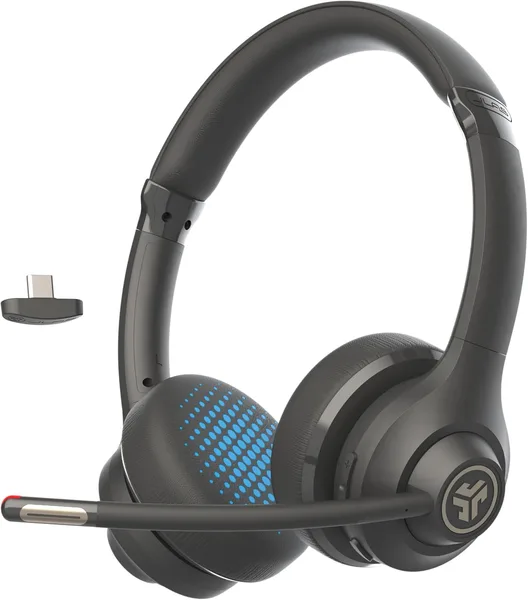
It's an over-ear headset with a flip-down boom mic — the kind that sticks out to the side like something out of an old-school call center. Not exactly glamorous, but it works. The USB dongle in the box is the real headline feature. Instead of fumbling with Bluetooth pairing that seems to forget your device for no reason, you plug a small dongle into your laptop's USB port and that's it — the connection holds firm, latency stays low, and you skip that weird crackle direct Bluetooth sometimes throws when the wireless spectrum gets crowded in an open-plan office or coworking space.
Multipoint isn't just a spec-sheet checkbox here either. You can genuinely keep a laptop connected through the dongle and a phone connected over Bluetooth at the same time — a mobile call comes through while you're sitting in a Meet, and switching between the two doesn't require any fuss. If your day involves running a negotiation while also waiting on a call from a client or a courier, that alone saves real stress.
How it holds up day to day
The microphone is the whole reason to pick this over a regular pair of wireless earbuds with a built-in mic. The boom sits close to your mouth during a call, so your voice comes through clearer, with less keyboard clatter and fan noise bleeding in. People on the other end stop asking "sorry, can you repeat that?" — and honestly, that alone justifies the purchase for anyone who spends their day on client calls.
The sound in the earcups themselves is just okay — and to be clear, this isn't a product to expect deep bass or a wide soundstage from. For podcasts and calls it's more than enough, and it's fine as background music while you work, but if you're the type who cranks full albums between meetings, it'll feel a bit flat. Stood next to the Jabra Evolve2 65, which often sits on the same shelf of office headsets, the JLab loses on audio detail but wins on price — a fair trade-off, and one worth knowing going in.
Battery life comfortably covers a full workday, and often stretches into a second day if you remember to power it off overnight. USB-C charging is the standard already sitting in half the gadgets in your house, so there's no extra cable to hunt down.
The over-ear fit stays comfortable for hours — the pads are soft and don't dig into your temples even after a long stretch. There is one catch: in warm weather, your ears do get a bit sweaty underneath them — a familiar story with over-ear designs in general, and the Go Work Gen 2 is no exception.
Who should buy it, and who shouldn't
If you're a freelancer, project manager, support agent, or anyone who spends most of the day on calls, this is exactly the kind of tool worth owning. The JLab Go Work Gen 2 lists at around $49.99 in its base offer, which puts it firmly in budget territory next to Jabra or Poly, brands that often start at double the price. Once you factor in shipping and import charges to your own country, the final number climbs — you can check the full landed price, item plus forwarding plus duty, on dede.sh — but even then it stays one of the more accessible entry points into the "dongle work headset" category.
If you're shopping for everyday headphones instead — running, listening to music on the train, watching videos — this isn't your pick. There's no flagship-level active noise cancellation and none of the bass you'd want from leisure headphones. For that, browse the wider headphones catalog on dede.sh — plenty of models there are built for fun, not for work.
The second downside is the look. The boom mic reads as office gear and a little dated if you're used to minimalist true wireless earbuds. Wearing this in a café or out on the street is a hard sell aesthetically, and that's worth knowing before you buy, not after.
Bottom line
This is a narrowly focused tool that does one job extremely well — calls — and doesn't pretend to be an all-purpose headphone. If your job means negotiations, meetings, and staying constantly reachable for colleagues or clients, the JLab Go Work Gen 2 will earn its price back within the first week of use. If you're after something for music and walks, look elsewhere in the catalog.
FAQ
Yes, if calls are your daily job. The dongle gives a more stable connection and lower latency than direct Bluetooth pairing, especially in offices packed with other wireless devices. For the occasional call once a week, the difference isn't worth chasing.
Jabra sounds better and runs a stronger noise-cancelling algorithm on the mic, but it costs noticeably more. If your budget is tight and the main goal is being heard clearly on calls, the JLab covers that need for a lot less money.
Yes, it handles a standard 8-hour day without trouble. If you're running a multi-day marathon of calls without a break, just charge it overnight — any USB-C cable will do the job.
You can, but don't expect much — the sound is tuned for voice, not bass or stereo width. For music, it's worth looking at dedicated models in the headphones catalog instead.