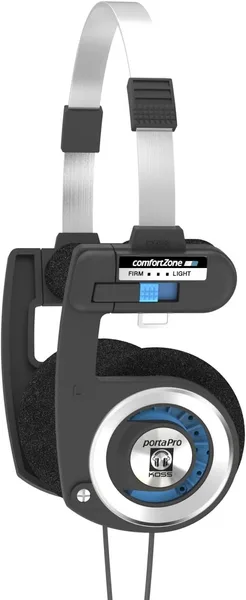
Koss Porta Pro Classic review: the headphones that haven't changed in 45 years
The Koss Porta Pro Classic is a relic from another era that's still sold almost unchanged since 1984, and that's exactly the point. The sound is warm, bassy, alive; the build is almost comically simple, which is precisely why it's nearly indestructible. Skip it if you need noise isolation for the subway or a mic for calls. Get it if you want wired sound you actually want to listen to at home or in the studio, for less than the price of a nice dinner out.
I run one test on every new pair of headphones: would I actually put them on when I'm just sitting at home with nowhere to be. Most modern TWS earbuds fail this test — they do their job on the commute, then sit in the case at home because who wants to fuss with pairing for a five-minute listen. The Koss Porta Pro Classic passes on the first try. Pick them up, drop them on your head, plug into the jack — you're already playing music. No Bluetooth, no app, no wondering whether they're charged.
That, actually, is the whole trick of this model — it's barely changed since 1984. Same adjustable headband with two thin arms, same driver design, same 3.5mm jack. Koss isn't chasing trends, and the Porta Pro Classic is living proof that "if it ain't broke, don't fix it" is sometimes exactly the right call.
How it actually sounds and feels
The first surprise is how bassy these little "cookies" on your ears turn out to be. The open-back drivers mean there's essentially no isolation — the person next to you will hear your music, and you'll hear their phone call. That's not a flaw, it's a design choice: open acoustics give you a more natural, "airy" sound instead of the boxed-in hum you get from cheap closed-back headphones.
The bass is punchy, juicy, arguably a bit much if you're used to the flat response of studio monitors. The mids are pushed forward a touch — vocals and guitars sound warm, almost analog, like listening to a vinyl record through a decent speaker. The highs aren't the most detailed on the market, but they don't get harsh at high volume either. If you're into punk, old-school hip-hop, or just music with some body to it, these will make you happy.
The headband deserves its own paragraph. It doesn't wrap over the top of your head like a normal headband — it hooks over your ears via two thin metal arms. At first it looks like something assembled from a nineties toy kit, and honestly, it kind of is. But wearing them this way is genuinely comfortable for hours: no pressure on the crown of your head, you barely notice them up there. One catch — on a run or at the gym they can slip, since they don't hold on as securely as over-ear models with a rigid headband.
Who it's for, and who should skip it
Stack these up against typical wireless earbuds at a similar price — think budget TWS off a marketplace, or even a name brand's entry-level model — and the Porta Pro loses on outdoor convenience but wins on sound quality when you're sitting still. There's no active noise cancellation, no call mic, no touch controls. The cable isn't especially long either, so your phone needs to stay somewhere nearby, in a pocket or on the desk.
These headphones are also something of a cult favorite among musicians and audio engineers. A lot of people keep a pair of Porta Pros around specifically for quick mix checks at home, because the sound is honest and not dressed up with some "signature" EQ curve the way most marketing-driven headphones are. If you make music, edit a podcast, or just want a reference point for how a track actually sounds, this is a cheap, time-tested option.
Who should definitely skip it: anyone who listens mostly on the move — subway, bus, street — since the open design loses badly to closed-back headphones there; city noise will swallow half the detail. They're also not for anyone who wants to handle calls or talk to a voice assistant through their headphones — there's simply no hardware for that. And if sweat resistance or water resistance matters to you for workouts, look elsewhere too; this isn't a sports model, even though some people have run in them for years.
Honestly, there's one real trade-off here: you give up all the modern conveniences — wireless, a mic, noise isolation — in exchange for warm, live sound at a bargain price. For some people that's an easy win. For others it's a real dilemma worth thinking through before buying, not after.
Street price for these sits shockingly low for headphones that still show up on "must have" lists four decades after launch — check dede.sh for the full landed cost to your country, item plus forwarding plus import duty, all in one number. Even with that added on, this stays firmly in budget territory, nowhere near premium pricing.
FAQ
FAQ
The premium here is minimal — the price is already low for headphones that sound this good. Compared to headphones in the $5-10 range, the difference is obvious immediately: more bass, cleaner mids, less distortion at volume. This is one of those rare cases where paying a bit more is genuinely worth it.
It depends on the scenario. For commuting, workouts, or calls, TWS wins hands down. But if you want to listen at home, in a studio, or at your desk, the Porta Pro delivers better, more honest sound than budget wireless models at a similar price, where most of the budget goes into the Bluetooth chip rather than the drivers.
Technically yes, but with an open design, you'll hear the street and the street will hear you. In a quiet courtyard or park that's fine; on the subway or next to traffic, not so much. If your "everyday" mostly means public transit, look at a closed-back model instead.
Actually the opposite — the simplicity is what makes it durable. There's no battery to degrade, no Bluetooth board to fail. The weak points are the thin cable near the jack, which you should avoid bending sharply, and the headband itself if you keep stretching it past its normal range.
If you want to compare against other wired options in the same price range, check out the picks below.