KVIDIO Bluetooth Over-Ear Headphones (65-Hour Battery): Honest Review
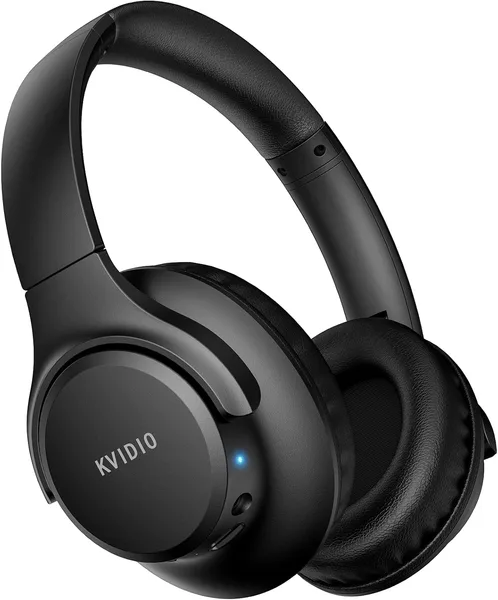
The KVIDIO Bluetooth Over-Ear Headphones are budget headphones priced like a fast-food combo, with genuinely impressive battery life. The sound isn't for audiophiles, but these will outlast any business trip or work shift you throw at them. Worth buying if your top priority is "won't die on me and I won't cry if I lose it" rather than studio-grade detail.
Picture this: you're on a three-day work trip, you forgot the charger at home, and your $200 headphones are sitting on a shelf back home, silently judging you. Sound familiar? This is exactly the situation cheap over-ear headphones with massive battery reserves were built for — you throw them in a bag, forget to charge them for days, and they still get you through the in-flight movie.
KVIDIO Bluetooth Over-Ear Headphones fall squarely into that category. The box says 65 hours of playback, and this isn't a case where the manufacturer just rounded generously in their own favor — even if real-world numbers land a bit lower (they almost always do; it's a law of both physics and marketing), you're still looking at a full week of daily use without ever going near an outlet. Compare that to something like the Sony WH-1000XM6 — an entirely different weight class in both price and ambition — and you'll notice there's no adaptive noise cancellation or proprietary sound-processing algorithm here. This is about something much simpler: it works, it plays, it holds a charge.
What it actually feels like to use
First impression: light. Not in a "cheap and flimsy" way, but in the sense that you forget you're wearing them after an hour. The headband is soft, the cups sit on your ears rather than fully enclosing them, so your ears don't turn into a sauna in summer — a genuinely important detail if, like me, you hate sweaty headphones on a hot subway ride.
The sound is an honest budget profile: boosted bass, slightly muted highs, and mids that do their job without any pretense of audiophile accuracy. For podcasts, shows, Zoom calls, and background music while you work, it's more than enough. If you're used to listening to jazz on reference headphones and catching every nuance of the recording — this isn't that. But honestly, how many people actually listen to music that way day to day? Most of us just hit play on a playlist and get on with our work, and for that scenario, KVIDIO does the job just fine.
The microphone is its own story. For calls in a quiet room, it's perfectly fine — your voice comes through clearly. Out on the street or in a noisy café, things get shaky, and whoever's on the other end will start asking you to repeat yourself. That's a typical weakness of budget headsets in this category, and KVIDIO doesn't break the mold here, for better or worse.
The Bluetooth connection holds steady at typical range — phone in your pocket to headphones on your head, no dropouts, and it doesn't cut out even with the phone sitting across the room in a bag. Multipoint connection to two devices at once, though, isn't on the table — that's a feature reserved for models a tier or two up.
What to compare it against, and who it's for
The real competitor to headphones like these isn't Sony or Bose — it's your old pair of wired headphones, or no headphones at all at your desk. The real question isn't "KVIDIO or a flagship," it's "KVIDIO or nothing." Framed that way, the choice is obvious.
Stack it against other budget options in the same price bracket — say, wireless earbuds with a power-bank case — and you're looking at a different philosophy entirely. This isn't about pocket compactness; it's about putting them on in the morning and not taking them off until evening. For long workdays, the over-ear form factor is objectively more comfortable than earbuds, which start digging in after the third hour.
On the marketplace, these run around $19 — cheap enough that no landed-cost math changes the verdict; check the full price to your door, shipping and duties included, on dede.sh before you buy. At that price, you shouldn't have any complaints about build quality or sound to begin with — this is squarely "buy it, use it, don't think twice" territory. Next to it, even mid-range headphones start to look like a purchase you actually have to think about.
The honest verdict
Who should buy these: students who live in headphones all day between lectures and library sessions; people who fly or take long train rides often and live in fear of a dead battery; anyone who loses headphones with impressive regularity and doesn't want to sweat the cost each time; office workers who just need something for daily calls and music, no frills required.
Who should skip them: audiophiles and anyone who seriously listens to music at home or in a studio setup — that's simply a different tier of need. Also skip if you rely heavily on calls in noisy environments — the mic will let you down. And if you need real active noise cancellation for flights or an open-plan office, look elsewhere; here it's either absent or symbolic at best.
The trade-off here is obvious and honest: you're swapping sound quality and premium features for battery life and price. That's not a hidden trap — it's exactly what you're paying for, or rather, not paying for. Go in understanding that trade, and you won't be disappointed.
FAQ
In practice you'll typically get somewhat less at max volume with Bluetooth 5.0+ engaged — that's normal for any manufacturer, since the number on the box comes from ideal lab conditions. But even 45-50 real-world hours is dramatically more than most over-ear headphones offer at this price point.
If you fly often or work in an open office with constant background noise, yes — the difference is physically noticeable. If your main environments are home, a private office, or everyday walks, the extra spend won't meaningfully improve your comfort, and that money is better spent elsewhere.
For short calls from a quiet spot, the difference is minimal. But for hours-long calls, over-ear wins — your ears tire out less. In noisy environments, though, earbuds with active mic noise cancellation are usually more accurate.
Technically you can, but that's not what they're built for — there's no sweat or moisture protection, and the over-ear design shifts around a bit during running. Fine for a session at the gym with weights, not for a run in the rain.
A few comparable options worth a look if you're still deciding: