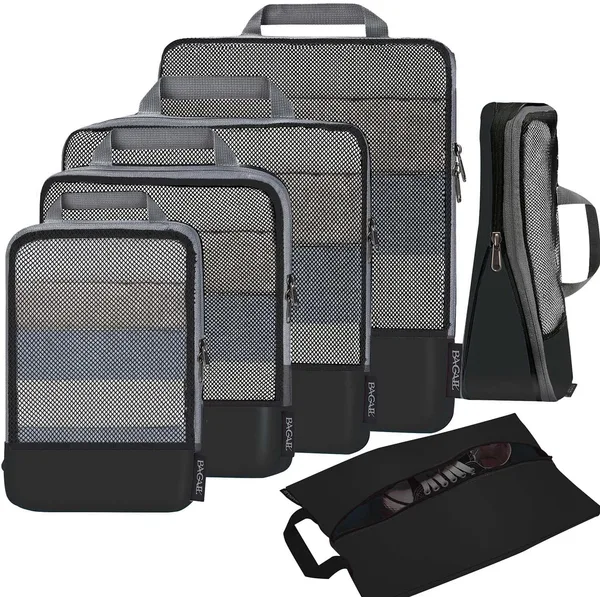
BAGAIL Compression Packing Cubes Review: Worth Buying?
BAGAIL isn't reinventing packing — it's a standard set of compression cubes that genuinely buy you 20-30% more room thanks to a second zipper. The fabric isn't premium, the zippers on the cheaper sets feel a bit flimsy, but for the price (roughly $23-24, see the full landed cost to your country on dede.sh) they do exactly what they promise. Get them if you travel often and hate playing suitcase Tetris. Skip them if you want something built to last a decade and don't mind paying more for Eagle Creek.
There's one moment in packing a suitcase I dread more than airport check-in: sitting on top of the case just to force the zipper shut, and it still won't close. Sound familiar? That's exactly the problem compression cubes were invented for, and BAGAIL Compression Packing Cubes are one of the best-selling options on Amazon in this category. Not because they're some brilliant innovation, but because they do a simple job without any unnecessary frills.
What this actually is
The idea isn't new: a fabric cube with a mesh top panel where you stuff your clothes, zip it shut, and you've got a standard packing cube like a hundred other brands sell. What sets BAGAIL apart is a second zipper running around the perimeter that squeezes the whole thing down to almost half its size. Fold in four t-shirts, zip the "compression" seam, and instead of a puffy roll you get a flat brick. Sounds like magic, but it's just mechanics — less air, less volume. There's zero secret sauce here, but it genuinely works, and that's exactly why these cubes have ended up in suitcases all over the world.
Sets come in packs of 4 to 8 cubes in different sizes — a small one for socks and underwear, a medium for t-shirts, a large for sweaters or jeans. You grab a set and sort by clothing type instead of just throwing everything in loose, which is honestly the real reason people switch to cubes in the first place. It's less about saving space and more about finding the shirt you need in thirty seconds instead of digging through the whole suitcase in a hotel room at six in the morning.
How it holds up in real use
The fabric on BAGAIL is a dense, nylon-like weave — pleasant to the touch, and it doesn't crinkle like cellophane (unlike some brands where every move of the suitcase sounds like a bag of chips). The mesh panel breathes well, so clothes don't get musty, which matters if you're packing damp sneakers or beach gear. The zippers are where things get less rosy. On two of the six cubes in a typical set (a common complaint echoed across customer reviews), the compression zipper's slider starts sticking after a while. Not a dealbreaker, but it's clearly not the same tier as an Eagle Creek Pack-It or an Osprey.
Compared to plain fabric pouches with no compression, the difference is obvious right away — a 40-liter carry-on fits noticeably more when clothes are squeezed flat instead of sitting in fluffy piles. Compared to vacuum bags (the kind you compress with a vacuum cleaner), BAGAIL loses on sheer compactness but wins on convenience: no plugging anything in, no hunting for a vacuum in a hotel room, and crucially, clothes don't wrinkle as badly as they do in a vacuum bag, where everything gets pressed into one solid block.
One more thing people rarely mention: compression isn't free. Fabric that's zipped tight over and over stretches out and fatigues over time. A year or two of regular use — and we mean actually regular, like a trip every month — the cubes handle fine, but after that the zippers start to sag. If you fly twice a year for vacation, a set will easily last you five years. If you're a digital nomad living out of a suitcase, expect to replace them annually, which is fair enough for this price bracket.
Who should buy, and who shouldn't
If you pack carry-on only and constantly try to cram a week's wardrobe into 40 liters, this is a genuine must-have. The volume difference is noticeable, and the price doesn't sting — a set runs around $23-24 on Amazon (see the full landed cost, including shipping and duties to your country, on dede.sh) — not pocket change, but not a splurge either.
Skip it if you mostly pack fragile items (compression will crush them) or if you're after something built for ten years of daily travel abuse — in that case, paying more for a sturdier brand with metal sliders is genuinely worth it. And honestly, for a short weekend trip, compression cubes are often overkill — everything fits fine without them.
The trade-off here is simple: budget price, budget hardware. The fabric and the concept are solid; the zippers are the weak link. But for the money, that's a compromise I can live with, especially since the set is modular — replacing one cube if it fails isn't a big deal.
FAQ
In practice, expect 20-30% less volume, not "half," as some listings claim. On soft items like t-shirts, underwear, and sweaters, the effect is immediate; on jeans or jackets, it's much more modest, since dense fabric doesn't compress well.
If you're flying quarterly or more, Eagle Creek will hold its shape longer thanks to sturdier zippers and fabric. If your suitcase only comes out of the closet twice a year, there's no reason to overpay — BAGAIL will earn its keep and then some.
A single 6-8 cube set really works for one traveler, or at most a couple sharing one suitcase. For a family with kids, get two sets in different sizes — kids' clothes are small and get lost among the adult items otherwise.
Yes, the fabric handles a gentle machine cycle fine. Just zip everything closed before washing — otherwise the mesh panel can snag and tear against the drum.
Worth a look too are related gear picks for packing a suitcase — everything from a hardshell case to a simple luggage scale so you don't get hit with an overweight fee at the gate.