BIQU CryoGrip Pro Glacier for Bambu Lab: is it worth ditching the stock plate
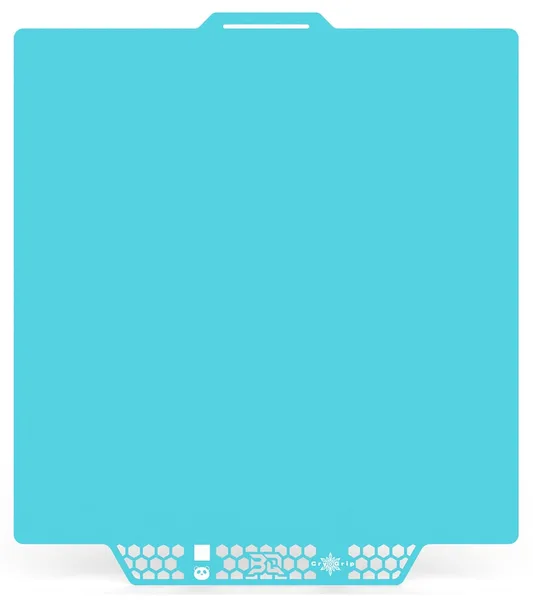
The BIQU CryoGrip Pro Glacier is a dual-sided magnetic build plate, 257×257mm, for Bambu Lab P1S/P1P/X1C/X1E/A1 printers, with "Panda"-style coating — textured PEI on one side, smooth on the other. The headline trick: it holds the first layer without glue stick even on ABS and PC, and once the plate cools, the part pops free with a single flex. Check the full landed price to your country on dede.sh (item + shipping + duty in one number) — but for anyone tired of fighting parts off the stock plate, this reads more like a quality-of-life upgrade than a hype gadget.
You know the scene: you're printing an ABS bracket for some homemade mount, everything's going fine, and then on the last layer a corner lifts, the part starts warping, and the printer keeps merrily printing on top of a part that's already crooked. Or the opposite happens — the part is welded so hard to the plate that you're prying it off with a scraper, risking either the coating or the print itself. Both scenarios are old news if you've been running a Bambu Lab for more than a couple of months. The stock plate on a P1S or X1C is decent, but it's a "works okay for everything" compromise, not something tuned for one specific material.
What this plate is, and how it differs from the stock one
The BIQU CryoGrip Pro Glacier is a replacement for Bambu Lab's standard magnetic plate, sized 257×257mm — so it fits the P1S, P1P, P2S, X1C, X1E, and, with a few mounting caveats, the X2. The "Panda" name has nothing to do with a print pattern; it's about the two-tone coating: one side textured (rough, black), the other smooth. Basically two plates in one — flip it over and you get a different surface finish for a different kind of print.
The CryoGrip concept itself isn't new — BIQU is essentially doing its own take on what Bambu already offers (Cool Plate, Textured PEI, Engineering Plate) and what third-party brands like Elegoo or Snapmaker sell too. The "Glacier" part of the name is the actual pitch: the coating is supposed to grip hard while the bed is hot and let go on its own once it cools, no prying required. In practice it does roughly what it promises — wait about five minutes after the print finishes for the bed to drop to around 40°C, flex the plate slightly, and the model just clicks free. For ABS and PC that's a real difference, because the stock Bambu plate can grab those materials so hard on some prints that getting the part off feels like a small fight.
Where it actually earns its keep, and where it doesn't matter
The scenario where the upgrade really shows is engineering plastics — ABS, ASA, PC, anything prone to warping and lifting at the corners due to shrinkage. The textured side of the CryoGrip holds these materials noticeably better than the stock smooth PEI plate, and this isn't a marketing "slightly better" — it's a difference you can see with your own eyes on the very first print. If you're mostly printing PLA trinkets — some Baby Yoda figure or a set of earbud holders — the stock plate is more than enough, and buying a CryoGrip just for PLA doesn't make much sense.
The second scenario is when your stock plate is already worn out. After a few hundred prints, PEI coating loses its grip: parts either come loose mid-print or, in the opposite failure mode, weld themselves on for good. Here the CryoGrip isn't really an "upgrade" so much as a consumable replacement, and the real comparison isn't "do I need this at all" but the price of an original Bambu spare part, which lands in roughly the same ballpark or a bit higher. Seen that way, the CryoGrip isn't about saving money — it's about getting a coating built for demanding materials for about the same spend.
A third, less obvious point: having both surfaces on one plate saves shelf space and the cost of a second plate. Instead of buying a Cool Plate and an Engineering Plate separately, one physical plate covers both scenarios — just flip it. The downside is that swapping it back and forth for every material change gets a little tedious if you alternate PLA and ABS within the same day.
Being honest about the trade-offs
The magnetic base wears over time too, and it matters that you don't flex the plate too hard or too often — once waviness shows up, or the magnetic layer starts separating from the aluminum backing, the coating stops sitting flat on the printer's bed, and that's a direct route to first-layer problems. The manufacturer claims hundreds of cycles, but as with any plate like this, real lifespan depends on how gently you flex it when popping parts off.
Second point: this isn't a genuine Bambu Lab part, and in theory thickness or magnetic strength can drift slightly from factory spec, which sometimes means recalibrating Z-offset after installation. In practice, most P1S/X1C owners just run one auto-calibration and never think about it again — but be ready for the first print to not go perfectly the first time.
And honestly: if your stock plate is still in good shape and you mostly print PLA or PETG without adhesion headaches, you don't need this upgrade. It solves a specific problem — demanding materials, or a plate that's lost its grip — not a universal "everything gets better" fix.
Who should buy it, and who shouldn't
Get it if you regularly print ABS, ASA, or PC and you're tired of fighting lifted corners or scraping parts off with a spatula. Get it too if your stock plate is already worn and needs replacing — the CryoGrip wins there simply by packing two coatings into one plate. Skip it if you mostly print small PLA trinkets for yourself or as gifts — the stock Bambu plate handles that with room to spare, and that money is better spent on something else from the 3D printing catalog, where you can compare the full landed price up front instead of just the seller's sticker number.
FAQ