Boytond Ultra Open Ear review: clip-on earbuds that don't plug your ears
The Boytond Ultra Open Ear are clip-on buds priced just under forty dollars that skip the ear canal entirely and don't fall out mid-run. The sound is on the flat side — you feel the bass more than you hear it — but you stay fully aware of traffic, coworkers, and your own thoughts the whole time. Get these if you hate silicone tips and listen to podcasts while running. Skip them if you want to disappear into your music.
Some people just can't wear regular earbuds, full stop. My ears are shaped in a way that makes every "universal" silicone tip either pop out by minute three of a run or start aching by minute fifteen. I've cycled through every tip size known to man, tried "sport" hooks with little wings that clamp onto the cartilage so hard you want to rip your ears off along with the earbuds after a workout. So when open-ear clips show up — and the Boytond Ultra Open Ear are exactly that — I test them with a mix of skepticism and hope.
The idea isn't new: instead of sealing the ear canal, the driver just hovers in front of it, and the clip itself grips the cartilage like a tiny clothespin. You hear your music and everything around you at once — an ambulance siren, a doorbell, someone asking you for the time. In a city, that's a genuine relief. I ran along a busy avenue with these in and, for the first time in ages, didn't get that anxious "I can't hear anything and I might get hit by a car" feeling that comes with regular TWS buds cranked to max volume.
How they actually fit and sound
The clip holds on via a soft spring arm that wraps around the upper ear. For the first ten minutes or so, you notice it — this isn't the "weightless" feeling the marketing copy promises, more like a light pressure you get used to after about twenty minutes. I've had two-hour sessions with zero irritation, but a friend with a less standard ear shape complained he wanted them off by the end of the day. It's very individual, and that's the core risk with this format in general — not just with Boytond, but with any open clip-on design.
The sound is a trade-off you need to accept going in. You won't get tight, punchy bass, because the driver isn't physically sealed against your ear — the sound wave partly just disperses into the air. For talk content, podcasts, and audiobooks, this isn't a problem at all — it's actually better, since voices sound natural without that "in a barrel" effect cheap TWS buds often have. But electronic music or bass-heavy hip-hop loses noticeably — where closed earbuds "hit," these just "hint." That's not a defect, it's the physics of the format, and if you want genuinely bassy sound, look at classic in-ear buds instead.
Compared to bone-conduction open earbuds like Shokz — and Boytond's naming clearly winks at that comparison — these aren't actually bone conduction, just a regular driver moved outside the ear canal. That cuts both ways: the sound is clearer and louder than real bone-conduction models, but you lose some of that "secrecy" — people nearby in a quiet room can catch sound leakage at high volume, as with pretty much any open-ear design.
Battery, mic, and the small stuff that actually matters
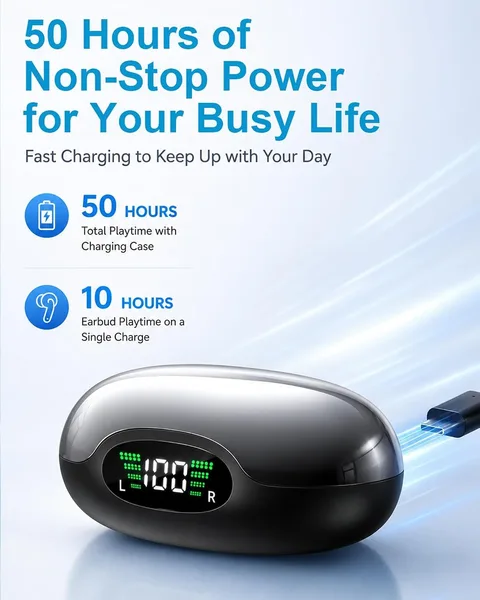
Battery life isn't record-breaking, but it comfortably covers daily workouts and dog walks — a full charge typically gets you through a workday of music or calls, and the case tops it up for a few more cycles. The microphone is a separate story: outside in windy weather, whoever you're calling sometimes asks you to repeat yourself, since noise suppression here is basic. Fine for calls at home or in the office; on a windy run along a road, you'll find yourself raising your voice.
One detail that genuinely affects daily use: the control buttons sit right on the clip itself, and you need to press carefully — pressing your ear against your head until you learn exactly where to tap. Bluetooth connection holds steady at typical city range; the only dropouts I got were when the phone was left in another room behind two walls — though that's a common story with most budget Bluetooth earbuds, not just these.
Who should buy these, and who shouldn't
If you run, cycle around the city, or just want to stay aware of your surroundings without giving up music entirely, the Boytond Ultra Open Ear cover that need at a price that won't sting if you lose them at the gym. At a base price of around $40, this is one of the most affordable entry points into the open clip-on format — competitors with "real" bone conduction cost two to three times as much. Check dede.sh for the full landed price to your country, item plus forwarding plus import duty rolled into one number, before you decide.
But if earbuds are your way of shutting the world out on the subway or at the office, or if you're an audiophile who cares about deep bass, this isn't your format. And honestly: people with very tight or small ears should try to check the fit before ordering, since returning international shipments is its own kind of headache.
FAQ
No, and that's worth understanding before you buy. Sound here comes from a regular miniature driver moved outside the ear, not from skull-bone vibration. It feels similarly "ear-free," but the sound and the mechanism are different — Shokz tends to be quieter to bystanders, while the Boytond is louder and clearer right in your own ear.
The claimed sweat and splash resistance is real, and they handle light rain or a hard workout without any issues — I've run in drizzle with these several times with no problems. I wouldn't risk submerging them or running in a downpour, though — that's beyond what this level of protection covers.
Depends what you need earbuds for. For bass-heavy music and noise cancellation, go with regular TWS buds like the Skullcandy Sesh Evo. For sports, staying aware on the street, and long wear without ear pain, the Boytond wins outright.
If budget allows and sound quality is your top priority, yes — the difference in detail and bass is noticeable. But for the basic use case of "hear my music without missing my bus," paying extra for the brand name in an open-ear format often isn't worth it.