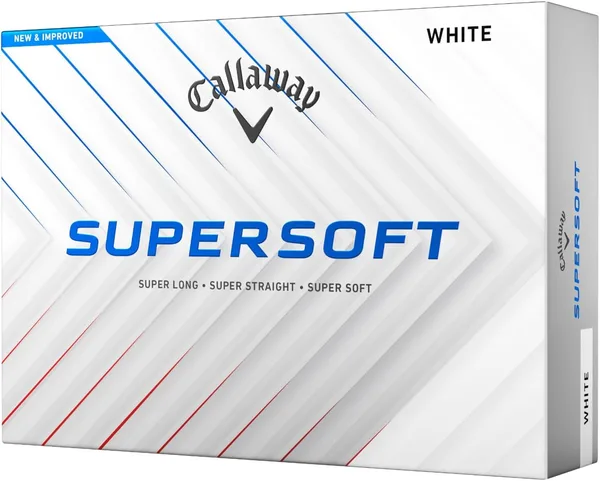
Callaway Supersoft (2025) review: are these golf balls worth buying?
Supersoft is a ball for anyone whose swing speed isn't anywhere near tour-pro territory and who's tired of paying for balls engineered around someone else's swing. Low compression means more distance off the driver and irons at slower swing speeds, and green-side control that's a step behind premium three-piece balls — a fair trade-off, not a manufacturing flaw. If your handicap sits somewhere around the average weekend golfer's and not single digits, buy without a second thought.
There's one thing about golf that almost nobody says out loud: most people on the course are playing balls built for a swing speed that isn't theirs. Tour balls with a three-piece construction and urethane cover — basically everything the pros endorse — only do their job when you're swinging the club the way pros swing it. If your honest swing speed is 85-90 mph rather than 110+, that ball simply doesn't compress enough at impact, and you lose the distance you paid extra for.
That's where the Callaway Supersoft comes in — a model that's been around for nearly a decade now, refreshed every year without any dramatic overhauls, because honestly, there isn't much left to change. The formula is simple: the lowest compression among mass-market balls, a big soft core that deforms even on a slow, gentle strike, and as a result, real extra yardage for the average weekend player.
What it feels like on the course
The first thing you notice at impact is the sound. It's duller, almost muted compared to the crisp click of a three-piece urethane ball. It throws you off at first — you're used to a "good hit" sounding sharper, and this feels dampened instead. But after a few holes you realize the sound doesn't matter, because the ball is flying. Off the driver the difference is immediate, especially if your swing speed is below average: the ball seems to stay on the clubface a beat longer, and that translates into yards you weren't getting before.
Around the green, though, it's a different story. The low compression that works so well on drives works against you here: spin on wedge shots is noticeably lower than premium balls like the Titleist Pro V1 or Callaway Chrome Soft. If you're used to stopping a ball with backspin or pulling it back off the flag, forget it — that trick isn't happening here. The ball rolls out further than you'd like, and on fast greens that can cost you a couple of strokes a round.
One more thing you don't notice right away: the Supersoft's cover (ionomer, not urethane) holds up better against scuffs from irons and bunker sand. So if you're the kind of player who regularly chews up balls with a sand wedge or sprays a few into the rough, there's less chance your ball looks beaten up by the back nine.
How it stacks up against the obvious rivals
The closest competitor is the Titleist Velocity — also two-piece, also built for distance-focused amateur golfers. The main difference is compression: the Velocity is a touch firmer and holds its line better in wind, while the Supersoft flies higher and feels softer off the putter face, which a lot of players subjectively prefer around the greens even when the actual control is comparable. Against premium balls like the Chrome Soft or Pro V1, the gap is more fundamental: you're paying half to a third of the price per dozen, but you're knowingly trading away spin and short-game control for distance and value. For a 20-plus handicap, that's a fair, sensible trade. If you're already playing single-digit golf and shaping your ball flight, it's not — you'd do better browsing the sports and outdoor catalog for something with higher spin control.
Skip the guesswork on pricing and check dede.sh for the full landed cost to your country — item price, forwarding, and import duty rolled into one number before you commit to a dozen. These balls sit at the budget end even by budget-ball standards, which is exactly why they're the default pick for anyone who loses a few a round and doesn't want to wince every time.
Who it's for, and who should skip it
Buy it if: you play once or twice a week, your handicap is somewhere between 15 and 30, your swing speed is average or below, and your main goal is more distance without overpaying for a ball that's going to end up in the water on the sixth hole anyway. It's also a great fit for beginners still finding their swing — losing a $5 premium ball stings, losing a Supersoft doesn't.
Skip it if: your handicap is under 10 and you can already feel the spin difference on short shots, or your game is built around controlling the ball near the pin rather than maximizing driver distance. It's also not a great match if you mostly play fast tournament greens — low spin genuinely costs you strokes there, not just a slightly different roll.
There's really one core trade-off here, and it's an honest one: you're swapping green-side control for distance and price. A smaller, less obvious one — the ball looks bright white out of the box but dulls quickly from grass and sand stains, even though the cover itself resists cuts and scuffs. Looks fade faster than performance.
Verdict
The Supersoft isn't a dream ball, and it never claimed to be. It's a workhorse for the vast majority of weekend players, and it does one thing honestly well: it hands back the distance that premium balls take away from a swing that can't compress them properly. If you're an average player who'd rather think less about the ball and more about the game, buy it without overthinking. If you've already outgrown that level, pay for the Pro V1 and don't look back.
FAQ
It's right on the edge. Distance off the tee and irons will be solid, but you'll likely already feel the lack of spin on wedge shots and around the green. If short game is critical for you, it's worth trying something with a higher spin rating instead.
They're not really a direct comparison — different categories entirely. The Pro V1 delivers control and spin for advanced players at roughly triple the price. The Supersoft delivers distance for beginners and weekend golfers for a fraction of the cost. The real question isn't "which is better" but "which one your swing can actually use."
No. If irregular play means you're not feeling the spin difference anyway, the money you'd spend on a urethane cover is going to end up buried in bunker sand — literally. A Supersoft or similar two-piece ball is the smarter budget call.
Not their strong suit. The low compression and lighter construction mean wind pushes the ball off line more than it would with a firmer ball like the Titleist Velocity. In calm conditions, you'd barely notice the difference.