Creality Glue Stick for 3D Printer Beds: Is It Worth Buying
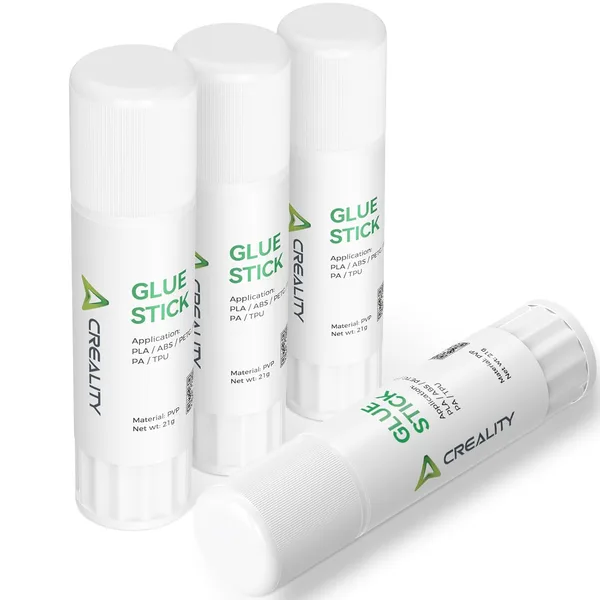
A regular stationery glue stick works for 3D printing, but it melts and smears by the third print. Creality's own PVP stick holds adhesion longer, doesn't gunk up your nozzle with drips, and costs pocket change — around 10 dollars a stick. Get it if you're printing ABS, PETG, or big flat parts that love to curl at the corners. If you're mostly printing small PLA trinkets, don't bother — a basic stationery glue stick from the supermarket will do the job.
Anyone who's ever lifted the printer's cover to find a corner of their part peeled off the bed and curling upward like an old photograph left in the sun knows that particular flavor of quiet rage. ABS does this almost every time, PETG does it whenever the bed's slightly uneven, and even plain PLA occasionally pulls the same trick if there's a draft in the room. That's where the most underrated accessory in 3D printing walks on stage: the glue stick.
Sounds trivial. Swipe it across the bed, what could possibly go wrong? Plenty, actually. I've tried a dozen options — from hairspray (yes, it genuinely works, though your nozzle ends up smelling like a salon afterward) to plain PVA thinned with water. I eventually settled on brand-name sticks, and here's why.
What this actually is, and why it matters
Creality's PVP glue stick is, at its core, the same stick glue kids use for school projects, just reformulated for a heated printer bed. You swipe a thin layer onto glass or a PEI sheet, the bed heats up to somewhere between 60 and 100 degrees, the glue "activates" slightly from the heat and forms a tacky film that the first layer bonds to hard. Once the part cools, that film turns brittle and the part pops off the bed on its own, no fighting with a scraper, no risk of gouging the plate or, worse, slicing your finger open (happened to me twice, both times because of the scraper, not the glue).
The main edge it has over a plain stationery equivalent is consistency. Cheap school-grade sticks are often either too runny or leave uneven lumps that get printed straight into your model's first layer as little warts. Creality's formula lays down more evenly, and you can genuinely see it on large flat bases — printing an electronics enclosure or a laptop stand, for instance.
Where it actually saves your print, and where it's just a convenience
It earns its keep most on ABS and PETG — materials that warp from uneven cooling. Here it's not cosmetic, it's insurance against a ruined six-hour print. Print a big Raspberry Pi case or a functional automotive part, and without adhesive a corner will simply tear loose across 40% of the model — I've watched it happen firsthand.
PLA is less critical. It sticks reasonably well to a clean PEI plate at 60 degrees on its own, and for small figurines glue is often unnecessary. But there's a catch: if your plate is old, worn shiny, covered in micro-scratches, or you're printing something with a tiny contact area (thin legs, narrow columns), glue still saves the day by adding the grip margin a tired surface no longer has.
Compared to hairspray, the main difference is mess. Hairspray sticks to everything nearby, not just the bed — your hands, the desk, the cat if it happens to walk by. A glue stick is dry, localized, doesn't float through the air, and doesn't settle on your linear rails. Compared to a spray adhesive like 3DLAC, the stick is cheaper and lasts longer, since you're applying it precisely instead of misting the whole bed.
What's annoying about it
The main issue with any glue stick is upkeep. Every 5-10 prints the layer wears thin or gets contaminated with fine plastic dust, and you need to wash the bed with warm soapy water and reapply. Laziness is the real enemy here, and it's exactly why people eventually switch to permanent textured plates that need no glue at all. The second downside is easy overapplication — too thick a layer and the bottom of your first layer comes out rough, like sandpaper. You need a thin, nearly transparent swipe, and that comes with practice, not on the first try.
One more thing: it's not a miracle fix. If your bed is poorly calibrated or the nozzle sits too high above the surface on the first layer, no glue will fix that — it only masks the problem briefly before things start lifting anyway.
Who should buy it, and who shouldn't
Get it if you print ABS, ASA, PETG, or nylon, or if your parts have a large footprint where every failed print costs you an evening and a spool of material. At roughly 10 dollars, it's cheaper than a single spool wasted to warping. Don't bother paying extra if you print exclusively small PLA models on a fresh textured plate — adhesion is already excellent there, and the stick will just sit unused.
Honestly, this isn't the kind of item worth waiting a month for a package from another continent. Buy it alongside something else from the 3D printing catalog so you're not paying full shipping for one small stick of glue.
FAQ
You can, and plenty of people do. But PVA is harder to apply evenly, and hairspray fouls up the printer and smells unpleasant when heated. A dedicated stick is simply more convenient for daily use — a thin even layer, dry hands, no fumes.
Mostly no — for PLA and even PETG, a textured plate holds the first layer on its own. Glue earns its place once the plate is old and worn shiny, or you're printing a warp-prone material like ABS, where extra grip never hurts.
Depends on how often you wash the bed and how thick you apply it. On average one stick covers a few dozen applications — months of regular printing if you don't overdo the layer thickness.
Yes, it works well on plain glass as well as on PEI sheets. The key is applying it thin and letting the bed warm up a bit before the first layer, so the glue "opens up" evenly.