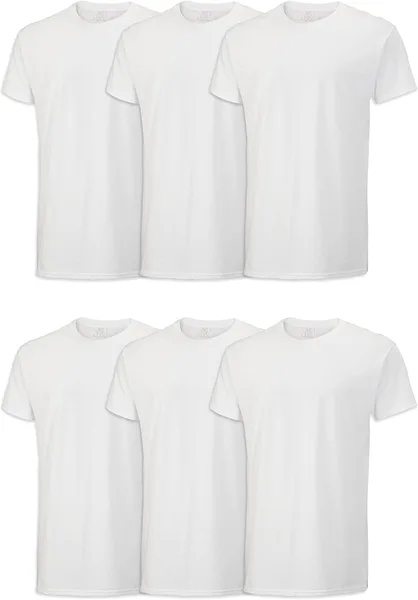
Fruit of the Loom Crew Tee Undershirts Review: Are They Worth Buying
Nobody buys this shirt to make an impression — they buy it to forget it exists. The Fruit of the Loom Crew Tee does exactly what a base layer under a dress shirt is supposed to do: no see-through, no ball-of-fabric after three washes, decent sweat-wicking. Check the full landed price to your country on dede.sh (item plus forwarding and import duty in one number) — for a multipack of basics like this, it's a genuinely sensible buy if you want a reliable wardrobe foundation rather than a fashion statement.
There's a category of things you only think about when they're missing. Socks. Your phone charger. And these undershirts belong right there with them — the layer nobody photographs for Instagram, but without which any cotton dress shirt turns damp and unpleasant within an hour. Fruit of the Loom has been making exactly this kind of unglamorous, dependable stuff for decades, and the new moisture-wicking Crew Tee line, with no scratchy neck tag, is more of the same philosophy: don't wow anyone, just don't let them down.
What this actually is
Strip away the marketing and it's a basic crew-neck undershirt sold as a daily base layer. Two real selling points: moisture-wicking fabric, and no sewn-in collar tag — the info is printed directly on the fabric instead. That second point sounds trivial until you've worn a shirt with the classic tag that saws at your neck all day, the one people eventually cut off with scissors mid-shift in an office bathroom. This shirt skips that problem entirely, and it's one of those rare cases where a line on the packaging describes an actual, felt convenience instead of just checking a marketing box.
Moisture-wicking is a more debatable claim at this price point. This isn't athletic-grade polyester built for a dry finish after a run — it's a cotton blend, so the effect reads more as "sticks to your skin less in the heat" than "bone dry." Under a dress shirt in summer heat, though, that's a real, noticeable difference, especially if you're the type who's already dreading a second change of clothes by lunchtime.
How it actually feels, not how it photographs
First impression: it sits a bit snugger than you'd expect from a "basic" tee. That's a plus — the fabric doesn't bag out under a thin dress shirt, so your silhouette stays clean. The flip side of that same trait: if you're between sizes, size up, because the cut runs closer to fitted than to the loose, boxy American cut Fruit of the Loom was known for a decade ago.
The collar holds its shape longer than you'll get from cheap no-name market brands — it doesn't stretch out within the first two weeks into scarf territory. The underarm seams don't chafe, which matters a lot for an undershirt, since that's exactly where holes tend to show up after six months of wear. Where there is a real issue: shrinkage. The first wash almost always pulls in the length a bit, so if you plan on tucking it in, size up or wash cold and skip the high-heat dryer setting.
Compared to Hanes or the cheaper multipacks sold in bulk at big-box stores, the fabric itself isn't radically different — the real edge is consistency. Pack to pack, there's less of a lottery effect where one shirt fits fine and the next one shrinks down to something a kid could wear. For a base layer you're buying as a set for the whole week rather than one shirt at a time, that consistency is exactly what justifies the small premium.
Who should buy it, and who shouldn't
If you're after an undershirt for the office, for a uniform, or just a summer base layer, this is one of the rare cases where paying up for the brand name actually pays off in practice. The Fruit of the Loom Crew Tee delivers on what it promises, and it does so consistently, pack after pack.
If you want a shirt to wear on its own — out the door, not hidden under a dress shirt — this isn't it. The cut and fabric are built specifically for the under-layer role, and wearing it visibly doesn't do you any favors: it reads plainly as an undershirt, not a standalone tee. Don't expect true athletic-level dryness either — if you need something for workouts or running, look at dedicated activewear built from polyester or merino wool; that's a different job entirely.
Compromise number one is the shrinkage after washing, already mentioned above. Compromise number two: this is, at the end of the day, a basic item with no real surprises — if you're hoping a cotton undershirt in this price range will feel "premium," it won't. What you get instead is the predictable quality that's the entire point of buying basics in the first place.
On price, this sits in a normal range for a multipack of undershirts at this level, and the full landed cost to your country — including forwarding and any import duty — stays well within reasonable territory. Browse the full clothing and footwear category on dede.sh if you want to build out a basics wardrobe as a set rather than piece by piece.
FAQ
If you're buying a single shirt, the difference isn't dramatic. But if this is your weekly base layer — washed two or three times a week and worn for years — the fabric and cut consistency from pack to pack is noticeably better with the brand name. The premium here isn't for the logo; it's for predictability.
It works, but don't expect the effect of a technical athletic shirt with mesh fabric. This is a cotton blend, so "dry" is relative — it sticks to your skin less in the heat and dries faster than plain 100% cotton. Under a dress shirt in the office, you'll notice it. For a workout, it's not enough.
Size up. The cut runs snugger than Fruit of the Loom's classic loose tees, and the first wash shrinks the length a bit further. Sizing down risks the shirt feeling noticeably short within a couple of weeks.
Technically yes, but there's not much point — the cut and the lack of any print or design are built specifically for the under-layer role. On its own, it just reads as a plain undershirt, not a proper tee for going out.