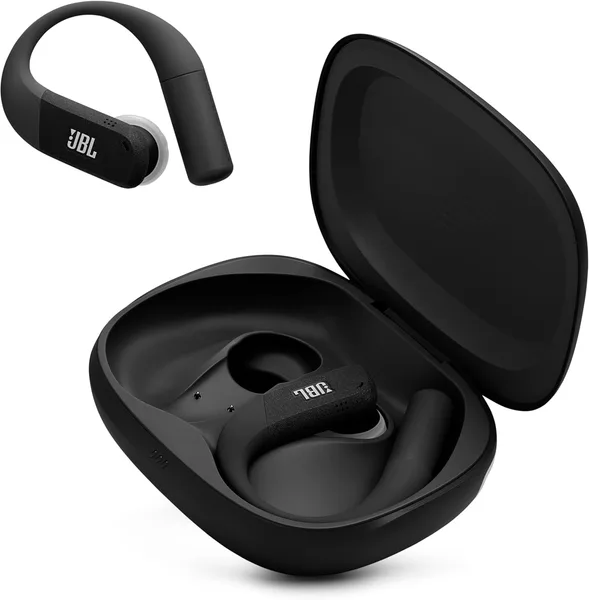
JBL Endurance Peak 4 review: worth buying for running and the gym?
The JBL Endurance Peak 4 is for anyone who's already burned through a couple of budget TWS earbuds on runs and is done fishing one out of a puddle. The fit locks in and stays there, the battery lasts a full week of training without a case recharge, and the ANC is solid, if not flagship-tier. If you're chasing the cleanest possible sound for album listening, look elsewhere. If you want earbuds that shrug off rain, sweat, and an elbow to the door on the way out — this is your pick.
There's a whole category of earbuds you don't buy for sound — you buy them to survive. You get yourself the latest "best" TWS, it sounds great on the couch at home, and a week later it's flying out of your ear at kilometer three, rolling under some stranger's feet. Sound familiar? That's exactly the problem JBL built the Endurance Peak 4 to solve.
First impression: the ear hooks feel a bit much — until you start running. Standard tips hold fine right up until real load kicks in: hill climbs, sharp turns, sprints. The Peak 4's design is built for exactly that. The case shape and the ear wings are engineered for movement, not for sitting still in an armchair, so they physically can't fall out. The first couple of runs feel odd, like something foreign is lodged in your ear, but that fades within a day or two.
Battery is the real headline feature. JBL claims up to 48 hours of total playback with the case, and in practice that holds up — you end up thinking about charging once a week instead of every night. For comparison, typical competitors in this price bracket give you 24-30 hours total, and you feel the difference precisely on the day you forgot to charge the case and there's a long run tomorrow. Here you can forget for two days straight and not panic.
Active noise cancellation is present, and it does its job at an everyday level — subway rumble, a running fan, a noisy office. But don't compare it to flagship Sony or Bose in terms of depth; that's a different engineering tier and a different price point. JBL's ANC is more about not getting distracted by background noise than about erasing the world entirely. And honestly, it shouldn't — full noise cancellation on a run alongside traffic isn't a feature, it's a hazard. That's why there's a transparency mode that genuinely helps when you need to hear a cyclist coming up behind you.
Sound is where honesty matters most. The bass is there, and you feel it — JBL has always leaned into that, since its audience mostly wants something energetic during a workout, not a classical recording. The midrange dips a bit, and you won't get audiophile-grade detail here. For podcasts, gym playlists, or a run, it's plenty. For critical listening, no — and that's fine, because that's not what this product is for.
Sweat and water resistance is the spec that actually swings the buying decision, so it deserves its own paragraph: the rating here is built for genuine sweat output and rain, not just the occasional splash. So don't rinse them under a tap, but training in a downpour or racing in the heat is exactly their territory.
Who buys these most often? Runners who've already lost a pair or two of TWS to sweat. Gym regulars tired of adjusting an earbud between sets. And anyone who just wants earbuds that survive a backpack, a pocket, and an accidental drop on asphalt without turning to junk within a month.
Who should skip them: if your top priority is the cleanest, most detailed sound for home listening, look at audio-focused models instead of sport ones. And if you need noise cancellation at the level of "can't hear the plane cabin," you won't find it here either — that's a separate, considerably pricier tier.
Marketplace price sits in the low three digits — check dede.sh for the full landed cost to your country, item plus forwarding plus import duty rolled into one number, which usually beats flagship ANC models in the same class, though it's not the cheapest option among sport TWS either. You can find something cheaper in the headphones category, but then you'll be trading off either battery life or fit.
Stacked against its closest rival in the sport ear-hook category — the Bose Sport Earbuds — Bose edges it out with slightly cleaner, more natural sound, but battery life is noticeably shorter and the case doesn't bail you out the same way. It's the classic sound-versus-stamina trade-off, and the Peak 4 deliberately picks stamina.
Overall, the JBL Endurance Peak 4 isn't a dream pair for audiophiles — it's a working tool for people who train regularly and don't want to think about charging or fit every single day. An honest product that knows its lane.
FAQ
Yes, with plenty to spare. 48 hours of total playback with the case means even an ultramarathon or multi-day training block won't drain it — you can realistically skip charging the case for several days in a row.
If your priority is never losing an earbud and not thinking about charging for weeks, go JBL. If sound quality matters more and you're fine charging more often, Bose sounds a touch more natural, but it loses on battery life and price.
Here, ANC is a nice bonus, not the main reason to buy. It cuts everyday background noise but won't match flagship cancellation from Sony or Bose. For outdoor training that's arguably better anyway — total silence out there is dangerous.
Yes, that's exactly what they're built for — the water resistance rating targets genuine sweat output and rain, not just the occasional drop. Submerging them underwater is still not a good idea.