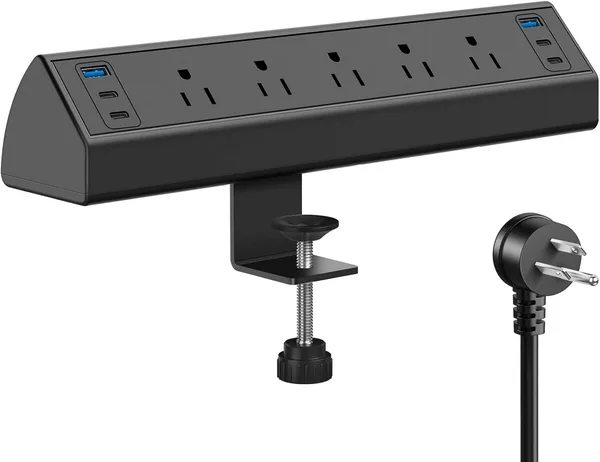
Jgstkcity Desk Clamp Power Strip USB-C 40W Review: Is It Worth Buying
A clamp that grabs the edge of your desk and hands you four USB-C ports at 20W each, sharing a 40W total — this thing isn't about raw power, it's about clearing your desktop. If you've already got three chargers and a rat's nest of cables sitting on your desk, this actually solves that problem. If you need serious power (a 65W+ laptop), look elsewhere.
See the dealFor about a year, a tangle of three adapters, two extension cords, and one charging brick lived under my desk, constantly falling and smacking my leg. Sound familiar? That's exactly who clamp-on strips like this one were built for — they bolt onto the edge of your desktop like a vise and drag your outlets up from the floor to eye level.
What it actually is, and why you'd want one
Jgstkcity Desk Clamp Power Strip USB-C 40W isn't a classic three-socket power strip — it's essentially a four-port USB-C hub with Power Delivery, each port rated up to 20W, but sharing a total budget of 40W across the whole group. Plug in four cables at once and each one averages around 10W — plenty for a phone or a pair of earbuds, not nearly enough for a laptop. That's the key thing to understand before buying: the "40W" on the box isn't "40W per port," it's one pie split between however many devices are plugged in.
The mounting is a clamp that grips a desk edge up to roughly 5cm thick. It takes about a minute to install — no drilling, no glue, no drama. Pull it off and your desktop is basically untouched, maybe a faint press mark if you've got soft wood with a thin lacquer finish.
Living with it day to day
The main use case here isn't laptop charging — it's the "small gadgets" zone: phone, wireless earbuds, a power bank, occasionally a tablet for bedtime reading. In that role it's flawless — charges are fast, cables don't dangle to the floor or stretch across the whole desk to some outlet by the baseboard.
Where it fell apart was when I tried charging my phone and a 13-inch MacBook Air at the same time — the laptop, plugged into this hub, charged noticeably slower than off its own brick. Makes sense: it wants 30W+, and the max any single port can offer while the others are active is well below that. If your main scenario is "charge a work laptop," get a dedicated 65-100W PD charger and keep this hub for phones and accessories — that's exactly how it settled into my setup: laptop on its own brick, everything else routed through here.
Compared to a standard wall power strip, the difference is fundamental: there are no outlets for appliances here, this is a pure USB-C solution. It doesn't replace a power strip — it complements one, for a desk that's already drowning in cables from USB gadgets specifically. Stack it against desktop charging stations from brands like Anker or Ugreen at similar wattage, and those usually sit on your desk taking up real estate, while this whole rig hangs off the side and basically disappears from view. That's arguably the strongest thing about it — not the power, but where it lives.
The cable running to the wall outlet is fairly short, so if your outlet is far from the desk, you'll need to add an extension cord — which undercuts the "everything in one place" pitch a bit. Minor annoyance, but it stings when you buy something specifically to clean up your desk and still end up running one more cord across the room.
The honest verdict
Get it if your desk is cluttered with small USB gadgets and you want the cables out of your sightline and the wall outlets freed up. It's especially handy for a gaming or office corner that's already packed with peripheral cables — at least the charging gear gets tidied away. Don't treat the price tag as pocket change for "just another power strip" — check the full landed cost to your country (item plus shipping and any import duty) on dede.sh before deciding, and think of it as an investment in tidiness rather than a cheap extension cord.
Skip it if your main need is charging a laptop, or several devices, fast and at full speed — 40W split across four ports is a compromise, and under full load every device gets less than you'd like. Also skip it if your desk is thinner or thicker than the clamp's range — measure your desktop before ordering, because returning something from overseas is its own headache.
There are really two trade-offs here: shared power instead of a fixed 20W per port, and a short power cable. Everything else is a plus, especially if you're as tired as I was of the cable spaghetti under your desk.
FAQ
Technically yes, but not quickly. If only the laptop is plugged in, it can claim a bigger share of that 40W and charging goes reasonably well. But the moment you add a phone or earbuds to the other ports, the laptop's share drops immediately. For fast laptop charging, keep a dedicated 65W+ PD charger around and use this hub for smaller devices instead.
If your desk is already cramped, the clamp wins — it hangs off the edge and doesn't eat any desktop space. If your desk has room to spare and you care about raw wattage per port, a classic desktop station from a brand like Anker or Ugreen usually splits watts more generously between ports. With this one, you're buying placement convenience, not a power reserve.
Don't risk it on glass — clamps like this are built for wood or particleboard, and tightening down on a glass edge can leave a hairline crack. Thickness-wise it usually works up to about 5cm, so measure a chunky gaming desk with a tape measure before ordering rather than eyeballing it.
This isn't a power strip in the traditional sense — it's purely a USB-C charging hub. If you also need an outlet for a desk lamp or monitor, this won't cover it; you'll still want a regular strip nearby.
Similar picks from the tools and workspace-gear category that people often grab to keep a desk or workshop tidy — worth a look alongside this one: