Lenovo Yoga 7i 2-in-1 16\": Review — Is It Worth Buying?
The Lenovo Yoga 7i 2-in-1 is a 16-inch transformer with a sharp 2K screen and Core Ultra 7 155U processor that handles everyday work and light editing without complaints, but don't expect gaming performance or exceptional battery life in its class. Buy it if you need one device that's both notebook and tablet for note-taking, not for benchmark bragging rights.
Picture this: you have one laptop for everything — work, streaming shows in the evening, and sometimes you need to sketch something online with a stylus during meetings because typing is getting old. A conventional clamshell laptop feels awkward here — you'd have to carry a tablet around too. That's exactly the scenario Lenovo designed the Yoga 7i for: a 360-degree hinge that lets you fold the screen into tablet mode, and a touchscreen that responds to fingers and stylus without lag in a way that feels almost physical.
First impressions come from the screen. 16 inches in 2K format (not just Full HD stretched for a checkbox) genuinely feels sharper when you're reading small text in spreadsheets or editing photos. The panel isn't the brightest on the market, but in a normally lit room away from direct sunlight, there's nothing to complain about. Take it outside in summer heat, though, and glare becomes a real issue you need to acknowledge honestly.
Under the hood sits an Intel Core Ultra 7 155U, clocked up to 4.80 GHz in turbo mode. This isn't the same chip in top gaming machines (those get H or HX series), but rather the economical U-series: built for the balance between battery life and performance rather than raw speed records. In practice, that means: Excel with a dozen tabs, Zoom calls with screen sharing, Photoshop for basic retouching — everything runs smoothly without hesitation. Heavy video rendering or demanding 3D tasks will make the processor work harder and the fan audible, though. The 16GB of DDR5 RAM and 1TB PCIe SSD show they didn't cheap out, and you feel the difference: the system doesn't gasp even with too many things open at once, and disk space covers both gaming libraries and work archives.
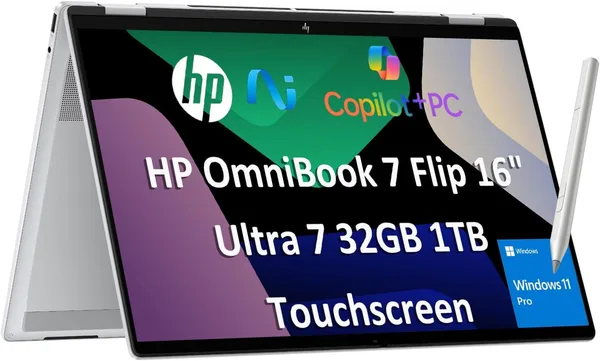
There are worthy competitors to compare against. The main spiritual rival is HP OmniBook 7 Flip, also a 16-inch transformer, also 2-in-1, but with a newer Intel Ultra 7 258V and twice the RAM — 32 GB. If budget allows, HP looks more future-proof. If you don't need a transformer and the 2K screen, you could save by going with a standard clamshell laptop from the same processor family, say HP 15 with Core Ultra 7 155H, also worth a look — slightly better performance at the cost of losing the tablet form factor.
Battery life is where the Yoga 7i doesn't shine. With mid-brightness and typical office work, you can get through a workday without an outlet, but without extra buffer. If you're the type who works coffee shop to coffee shop and forgets to pack a charger, you'd be better off keeping a power brick in your bag from the start. It's not critical — just not the kind of device you can brag about lasting three days on one charge.
The keyboard is pleasant with soft key travel and backlighting — typing long texts is comfortable, and your hands don't cramp even after hours. The touchpad is large and precise with a smooth glass surface. The speakers, though, are typical for thin transformers: flat and hollow — better to bring headphones for music or film. Windows 11 Pro comes installed, which is a plus for corporate environments with domains and group policies; home users won't feel much difference except paying extra for the license, which is already baked into the price.
Weight and dimensions: 4.6 pounds — more than two kilograms, noticeable for a 16-inch transformer you plan to carry daily in a backpack. Not the lightest option if portability ranks above screen size.
Who should buy this: someone who needs one device for office work, document handling, light photo editing, and periodic stylus note-taking — a graduate student, project manager, freelance designer without heavy 3D work. Who should definitely pass: gamers (there's a dedicated class of gaming laptops with discrete graphics), and anyone for whom battery life is the absolute priority — look at ARM solutions or MacBook instead.
The base offer starts at $899.99 — this is the marketplace price for the product alone, not including shipping and import duty to your country, so budget extra for the final bill. Check the full product card with current offers before purchase — exchange rates and offer availability change.
Two real compromises to remember: mid-range battery life and an audible fan under loads above everyday use. If neither is critical for you, the Yoga 7i honestly earns its price.
FAQ
For basic retouching, cropping, and color correction — absolutely. For heavy panoramas or stacks of 50+ RAW files, the processor will start to noticeably slow down, and you'd be better off looking at H-series or discrete graphics.
If you plan to read a lot, edit text, or view photos — yes, the difference is noticeable right away. If your laptop is mostly for video calls and browsing — Full HD meets the need more cheaply, and the premium isn't critical.
If budget isn't limited, HP with the newer chip and 32 GB looks like a more future-proof choice. If you prioritize price for a 2K screen and transformer — Yoga 7i holds its niche confidently.
Light games on low settings, yes. Modern AAA titles, no — there's no discrete graphics card, and that's exactly why U-series processors aren't designed for it.